What Is Driving the Shift to AI Agents in the Enterprise?
Enterprises are deploying AI agents faster than they’re building the governance to manage them. The result is AI Agent sprawl: the uncontrolled proliferation of AI agents across an enterprise, accumulating quietly, one locally rational deployment at a time, until leadership can no longer answer a basic question: how many AI Agents are running right now, and who owns each one?
This blog breaks down what that misalignment looks like, why it’s accelerating in 2026, and how a genuinely AI-first operating model differs.
What Is AI Agent Sprawl?
AI Agent sprawl is the uncontrolled proliferation of AI Agents across an enterprise, outpacing governance, visibility, and accountability structures.
It does not announce itself. It accumulates.
A customer experience team deploys a conversational agent. Finance builds an agent to automate invoice reconciliation. IT spins up an agent for Level 1 support. Marketing connects an agent to the CRM. Each decision is locally rational. Each deployment is, in isolation, a success.
Multiply that across business units, geographies, and quarters, and the enterprise has a fleet of autonomous actors with no unified visibility, no consistent governance, and no coherent accountability structure.
That is AI Agent sprawl.
Is AI Agent Sprawl the Same as Shadow AI?
Shadow AI refers to unsanctioned AI use, tools, and models that IT doesn’t know exist. AI Agent sprawl is a different problem: it can include agents that were fully approved and sanctioned by every relevant team. The failure isn’t authorization. It’s the absence of unified governance, visibility, and accountability across a growing, distributed fleet, whether that fleet was sanctioned or not.
Whether sanctioned or not, this kind of unchecked growth doesn’t stay contained. To understand why it’s compounding now, and why 2026 is the inflection point, it helps to see how enterprise AI transformation has evolved.
Why Is Enterprise AI Shifting from Tool Adoption to an Operating Model?
For most of the last decade, enterprise AI meant models: predictive engines, recommendation systems, classification tools. These informed human decisions. They did not make them.
AI Agents are categorically different.
They execute tasks, call APIs, trigger workflows, and make sequential decisions, often without a human in the loop. In multi-agent architectures, agents orchestrate one another. They operate continuously across systems at the speed of light, with a human expert serving as a supervisor.
This is not an incremental upgrade. It is a structural shift.
Stop agent sprawl before it scales
Get the framework for governing enterprise AI agents
Traditional AI vs. Agentic AI: What's Actually Different
| Parameters |
Traditional Enterprise AI |
Agentic Enterprise AI |
| Execution model |
Single-purpose automation |
Autonomous, multi-step workflows |
| Decision trigger |
Human-initiated actions |
Goal-driven, self-directed execution |
| Data & System access |
Limited to one system or dataset |
Enterprise-wide context and access |
| Coordination |
Individual tools, siloed outputs |
Coordinated multi-agent ecosystems |
| Oversight model |
Humans review before action |
Agents act, then report. Human reviews |
The implications of this shift are not primarily technical. They are organizational when AI moves from advising humans to operating alongside, or instead of them; the questions that matter most change entirely.
It is no longer: Is the model accurate?
It becomes: Who is accountable when the agent is wrong? How do we audit what it did? What happens when 40 agents, deployed by 12 different teams, start making conflicting decisions?
Most enterprises do not have answers yet.
What the Research Says About Where Enterprises Stand Right Now
This shift is not speculative. The data makes the urgency concrete.
| Finding |
Source |
| More than 50% of enterprises will have deployed Agentic AI by 2027 |
Gartner |
| 33% of enterprise software applications will include Agentic AI by 2028, up from less than 1% in 2024 |
Gartner |
| AI risk and governance remain among the top cited barriers to scaling AI across the enterprise |
McKinsey State of AI |
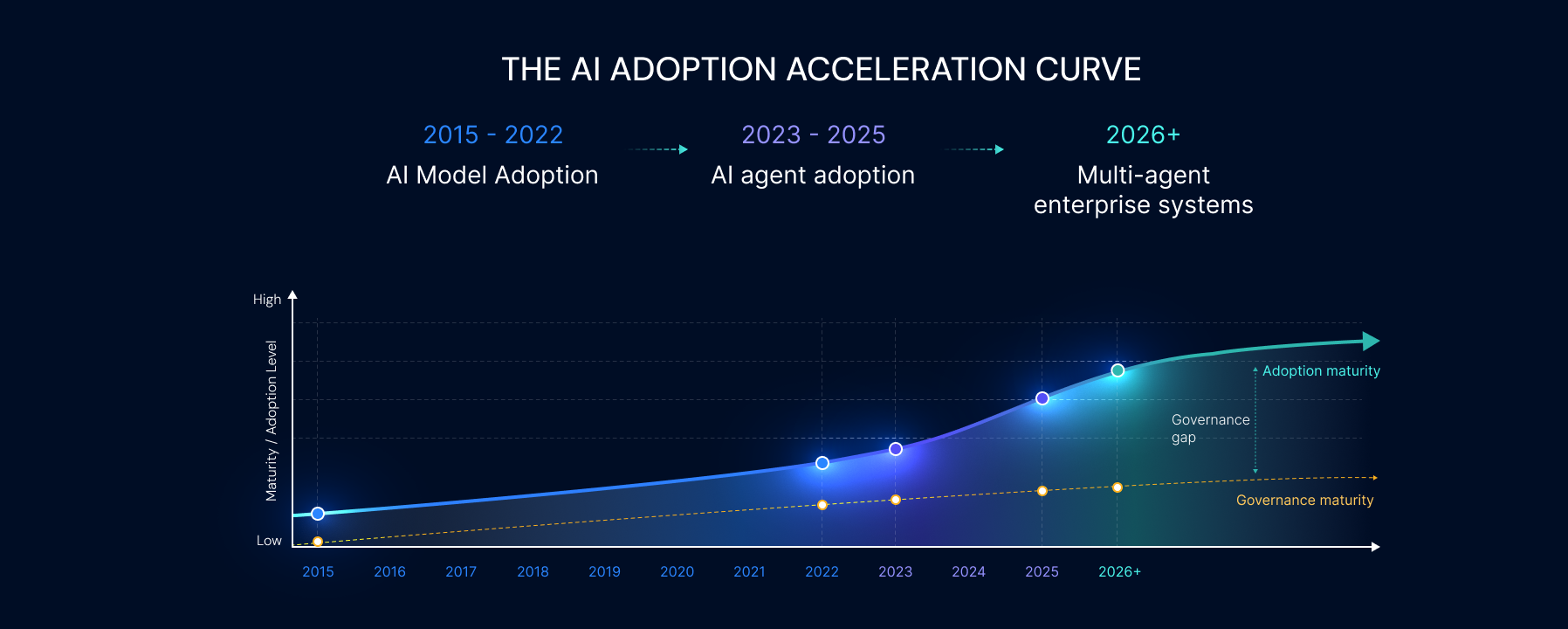
The pattern is consistent across every major research source: deployment is outpacing governance, and the cost of that gap compounds with every agent added to the fleet. That gap isn’t abstract, it shows up as specific, recognizable patterns inside enterprises today.
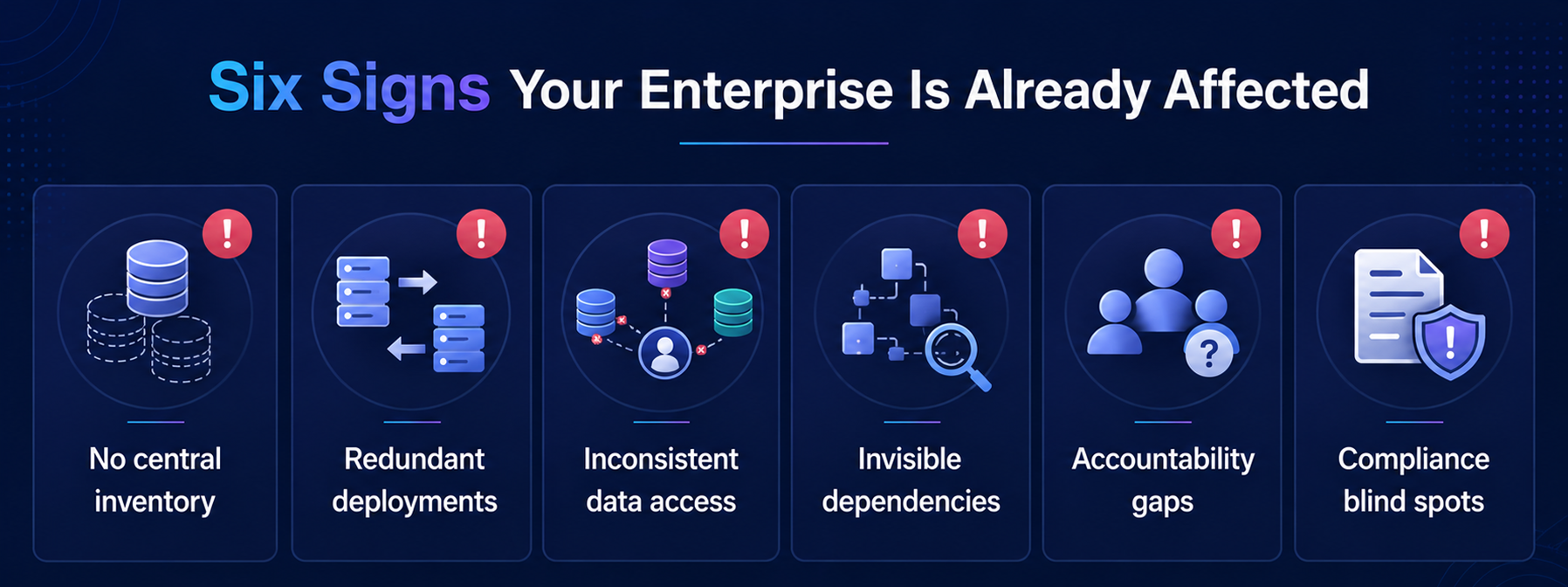
What Are the Six Signs Your Enterprise Is Already Affected?
- No central inventory: Leadership cannot answer ”How many AI Agents are running right now, and who owns each one?“
- Redundant deployments: Multiple teams have built agents that solve the same problem, duplicating cost and creating version conflicts
- Inconsistent data access: Different agents access overlapping datasets under different permission levels with no unified access policy
- Invisible dependencies: Agents trigger downstream systems and other agents in ways that were never mapped or approved
- Accountability gaps: When an agent produces a wrong output or takes a harmful action, there is no clear owner
- Compliance blind spots: Agents handling sensitive data operate outside the visibility of legal, risk, and compliance teams
Recognizing one or two of these signs isn’t unusual. The real risk is how quickly they multiply.
Why Does AI Agent Sprawl Get Worse as Enterprise Adoption Scales?
Sprawl is not a deployment problem. It is a scaling problem.
In the early stages of AI adoption, most enterprises manage agents informally. There are few enough of them that a shared inventory or a monthly IT review is sufficient. Risks are visible. Owners are known.
But AI adoption does not scale linearly. It accelerates. As more teams see productivity gains from early deployments, demand compounds. Low-code and no-code agent builders have reduced the technical barrier to near zero. Business units no longer wait for IT. They build.
This is where the structural gap opens.
| Early Adoption Stage |
Scaled Adoption Stage |
| Few agents, centrally deployed |
Many agents, distributed across teams |
| IT owns and monitors all agents |
Business units deploy independently |
| Governance is informal but sufficient |
Governance frameworks have not kept pace |
| Risks are visible and contained |
Risks are diffuse and compounding |
| Agent interactions are simple |
Agents orchestrate other agents |
| Accountability is clear |
Accountability is fragmented |
The jump from the left column to the right does not happen gradually. It happens faster than most enterprises anticipate. And by the time leadership recognizes the problem, sprawl is already embedded in operations.
What Are the Consequences of Ungoverned AI Agents in Enterprises?
When AI Agent sprawl goes unaddressed, the impact surfaces across five dimensions simultaneously.
- Operational: Redundant agents produce conflicting outputs. Teams make decisions based on different AI-generated recommendations without knowing the recommendations contradict each other. Workflows that depend on agent outputs become brittle when agents are updated or retired without coordination.
- Financial: Sprawl compounds costs long before it becomes a governance issue. Different teams build near-identical agents, each with its own infrastructure, model subscriptions, integrations, and maintenance overhead. Shadow procurement adds to this: teams independently paying for overlapping LLM tiers or agent-builder tools with no consolidated vendor leverage. Without central visibility, the enterprise pays multiple times to solve the same problem. Every duplicated agent is a duplicated bill. You cannot control cost in a fleet you cannot see, same as you cannot govern what you cannot name.
- Security: Each agent is a potential attack surface. Agents accumulate access credentials, API keys, OAuth tokens, and database connections that are rarely audited or rotated. A compromised agent does not just expose one system. It exposes every system it touches and, potentially, every agent it interacts with.
- Governance and Compliance: In regulated industries such as banking, insurance, or healthcare, agents who handle customer data, make credit decisions, or process medical records are subject to strict regulatory requirements. Sprawl means those agents are frequently operating outside compliance visibility. The regulatory exposure is not theoretical. It is a matter of when, not if.
- Organizational: Perhaps the most underappreciated consequence is that sprawl erodes trust in AI itself. When agents produce inconsistent outputs, when no one can explain a decision, when a bad outcome has no clear owner, leadership pulls back. The enterprise that was accelerating AI adoption hits a trust ceiling that is very difficult to recover from.
What Is the Enterprise AI Control Framework, and How Does AiDE® Deliver It?
Addressing AI Agent sprawl requires more than a governance policy or a monitoring dashboard bolted on after the fact. It requires a foundational operating layer, one that manages agents from the moment they are registered to the moment they are retired.
The Enterprise AI Control Framework defines that layer across five capabilities. AiDE®, ValueLabs’ Agentic AI platform, is built to deliver each one.
| Pillar |
What It Means |
How AiDE® Delivers It |
| Registry
Know every agent you have |
A single source of truth: every agent cataloged, owned, versioned, and tracked through its full lifecycle. You cannot govern what you cannot name. |
Unified platform where all agents are cataloged, owned, and versioned. |
| Orchestration
Coordinate how agents work together |
Centralized coordination of multi-agent behavior: task routing, conflict resolution, shared context, and memory. |
Multi-agent pipelines coordinated under one environment, from finance AP automation to engineering RCA workflows. |
| Governance
Enforce policy by design, not by exception |
Centralized guardrails, data protection, model governance, and access control applied uniformly across every agent. |
Fabric, a central governance kernel that enforces input/output guardrails, PII/PHI filters, and multi-LLM policy across every agent. |
| Observability
See what every agent is doing |
Real-time monitoring, decision traceability, audit trails, and automated root-cause analysis. |
Source Citation, Narration Agent, and RCA Agent provide decision traceability and audit-ready reporting. |
| Human Oversight
Maintain accountability at every level |
Defined ownership, clear escalation paths, human-in-the-loop controls for high-risk decisions. Autonomy without accountability is liability. |
Supervised and autonomous operating modes with defined escalation paths and explainable decision outputs. |
See how AiDE® maps to your current agent inventory.
Is Your Enterprise’s AI Governance Reactive or Proactive?
Knowing the five pillars is one thing. How an enterprise actually operationalizes them is another, and it typically falls into one of two postures. The difference isn’t whether governance exists, but whether it’s built in from the start or stitched on after something goes wrong.
- Inventory: Reactive governance creates an inventory after incidents. Proactive governance maintains one continuously.
- Audit Cadence: Reactive governance relies on manual audits on a schedule. Proactive governance runs automated, real-time observability.
- Ownership: Reactive governance sits at the department level. Proactive governance holds enterprise-level accountability.
- Security Timing: Reactive governance reviews security after deployment. Proactive governance embeds it by design.
- Governance Posture: Reactive governance treats governance as a compliance exercise. Proactive governance treats it as an operational capability.
What's the First Operating Model Question Enterprises Should Ask?
ValueLabs’ approach begins before the first agent is deployed. The foundational question is not ‘Which agents should we build?’ It is ‘How does this enterprise need to be structured to absorb AI Agents without losing control, coherence, or accountability?’
That means engaging at the level of workflow redesign, organizational structure, data architecture, and governance, not just implementation. It means asking the hard questions early, not after sprawl has already set in.
AiDE® is built to operationalize that answer, enabling enterprises to build, deploy, orchestrate, and govern AI Agents across the enterprise under a single controlled environment, as the framework above shows.
Why Does Depth in Regulated Industries Matter?
Sprawl is a universal problem. Its consequences are not equally distributed.
In BFSI, Healthcare, and Insurance, the compliance exposure from ungoverned agents is existential, not just operational. ValueLabs’ vertical practices bring domain-specific governance knowledge that a horizontal platform vendor cannot replicate.
The question is not only ’Is the agent governed?’ It is ’Is it governed in a way that satisfies your regulator?’
Conclusion
AI Agent sprawl is not a sign that an enterprise adopted AI too aggressively. It is a sign that the operating model did not keep pace with the adoption.
The enterprises that will lead the next decade are not the ones that deployed the most agents. They are the ones that built the organizational architecture to run them with visibility, governance, and accountability embedded at every layer.
That is not a technology problem. It is a transformation problem.
ValueLabs exists to help enterprises navigate that transformation with a framework, a platform, and domain depth to make it real. Ready to build the operating model your AI Agents need? Talk to our experts about the Enterprise AI Control Framework.
“Deploying agents was never the hard part. Being able to stand behind what they did, six months later, in an audit or a boardroom, that’s the part most enterprises haven’t built for yet.”