The Architectural Shift: From AI Investments to Enterprise Orchestration
The next architectural layer in banking is not another model. It is the orchestration layer that finally enables every AI investment a bank has already made to work as a single enterprise under a single governance framework.
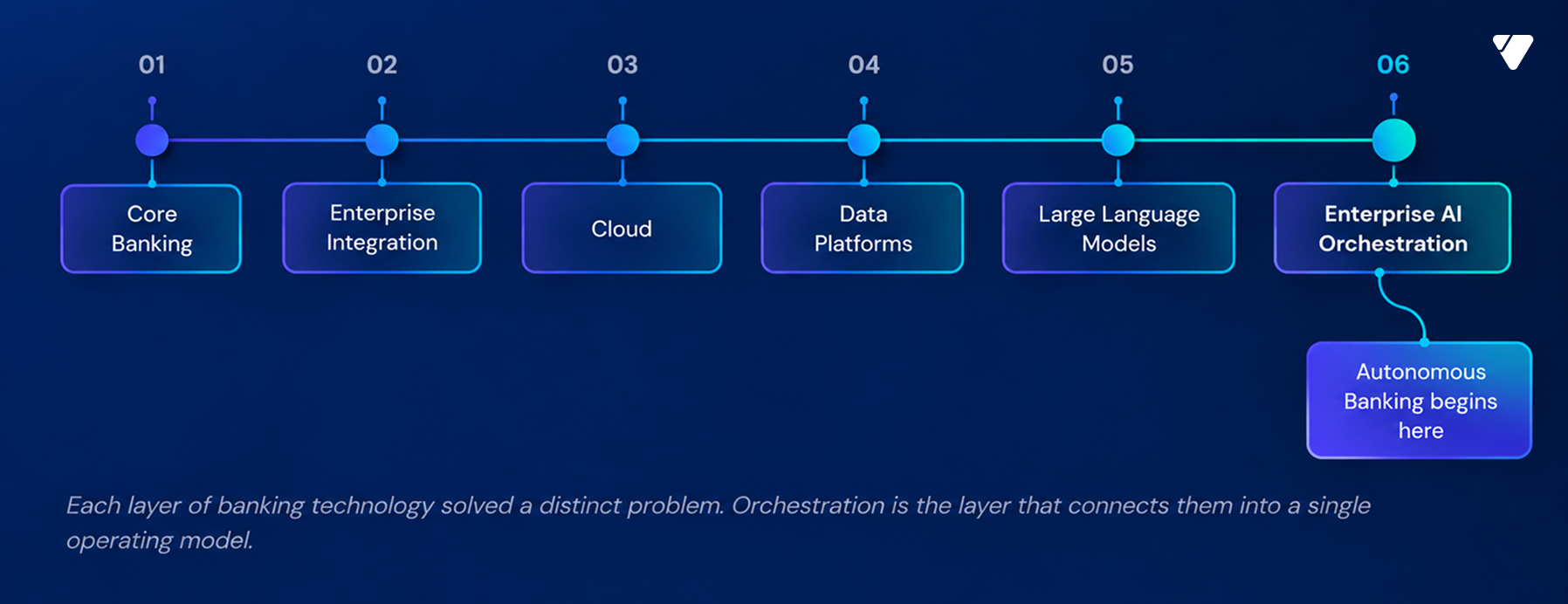
The banking industry has spent three decades earning the right to call itself digital. Core banking systems digitized transactions. Enterprise integration connected applications. Cloud modernized infrastructure. Data platforms unified enterprise information. Large language models introduced conversational intelligence. Each layer solved the problem in front of it and left the next one for someone else to solve.
The next problem is orchestration. Not a new model, not another chatbot, not one more pilot competing for budget and attention. What comes next is the layer that lets everything a bank has already built work together, as one coordinated, governed, intelligent enterprise.
At ValueLabs, we call this Autonomous Banking. It is not a rebrand of Agentic AI, and it doesn’t ask a bank to tear down platforms built over years of investment. It starts by enabling those platforms to operate as an intelligent, coordinated ecosystem, governed end-to-end by the institution that owns them.
Every Bank Is Building AI. Few Are Building an Autonomous Enterprise.
Over the last two years, financial institutions have invested significantly in generative AI. Private LLMs. Enterprise knowledge platforms. Cloud-native data architectures. Modern API ecosystems. Automation platforms. These investments are essential and, on their own, incomplete.
Across nearly every banking institution we work with, we see the same pattern. Ten, twelve, sometimes fifteen parallel AI initiatives running at once, each one genuinely valuable in isolation, none of them speaking to each other. A fraud signal generated in risk has no way to inform a service conversation occurring in the contact center. A compliance check completed for a lending decision cannot be reused an hour later when the same customer raises a payments query. The intelligence exists across the enterprise. It simply cannot move across the enterprise.
Large language models generate intelligence. Autonomous Banking requires orchestrating that intelligence across thousands of interconnected processes, applications, policies, and decisions.
Without orchestration, AI remains fragmented, a portfolio of clever point solutions rather than an enterprise capability. With orchestration, that same portfolio becomes something categorically different: a bank that reasons, executes, and improves as one coordinated system.
Why Enterprise AI Orchestration Matters
A bank does not operate through isolated functions, and it cannot be made autonomous one function at a time. Every customer interaction sets off a chain of downstream processes spanning payments, fraud, lending, compliance, risk, treasury, customer service, and IT operations. Autonomous Banking requires all of these functions to work together, not as disconnected AI assistants scattered across the organization, but as coordinated enterprise agents operating with shared context, shared enterprise knowledge, and policy-driven governance.
Enterprise AI Orchestration provides the coordination layer. It is what allows AI to move beyond answering questions and begin executing business outcomes, not independently, and not without oversight, but within the operational guardrails the institution itself has defined.
Still running AI in silos? Orchestrate every investment into one governed system.
Connect your AI investments through intelligent orchestration to improve scale, governance, and enterprise-wide impact.
AiDE®: ValueLabs Enterprise AI Operating System
This is the thinking behind AiDE®, ValueLabs Enterprise AI Operating System. AiDE® is designed to sit above a bank’s existing technology landscape, orchestrating intelligence across business and technology functions while preserving every investment the institution has already made.
Rather than replacing existing platforms, AiDE® integrates with:
- Core banking systems
- Payments platforms
- CRM
- Enterprise data platforms
- Cloud infrastructure
- Service management
- DevSecOps toolchains
- Enterprise knowledge repositories
- Existing LLM ecosystems
- Workflow engines
The result is a unified intelligence layer capable of coordinating enterprise-wide autonomous operations, bringing all these systems into a single, governed operating model rather than leaving each to run its own isolated version of ‘AI.’
Built Around the Bank's Existing AI Strategy
Every bank has a different AI strategy. Some prefer proprietary LLMs. Others deploy open-source models. A growing number are adopting sovereign AI models to address regulatory and data-residency requirements. AiDE® is model-agnostic by design. It does not ask a bank to replace its AI investments. It enables those investments to work together through a common orchestration layer, allowing the institution to evolve its AI landscape without vendor lock-in, while retaining complete control over governance, security, and compliance.
From Individual AI Agents to an Enterprise AI Workforce
Autonomous Banking cannot be achieved through isolated AI Agents working in parallel. Enterprise value comes from collaboration. AiDE® enables specialized agents across every banking function to operate as a coordinated digital workforce, each with a distinct mandate, all sharing enterprise context, shared memory, and policy-driven governance.
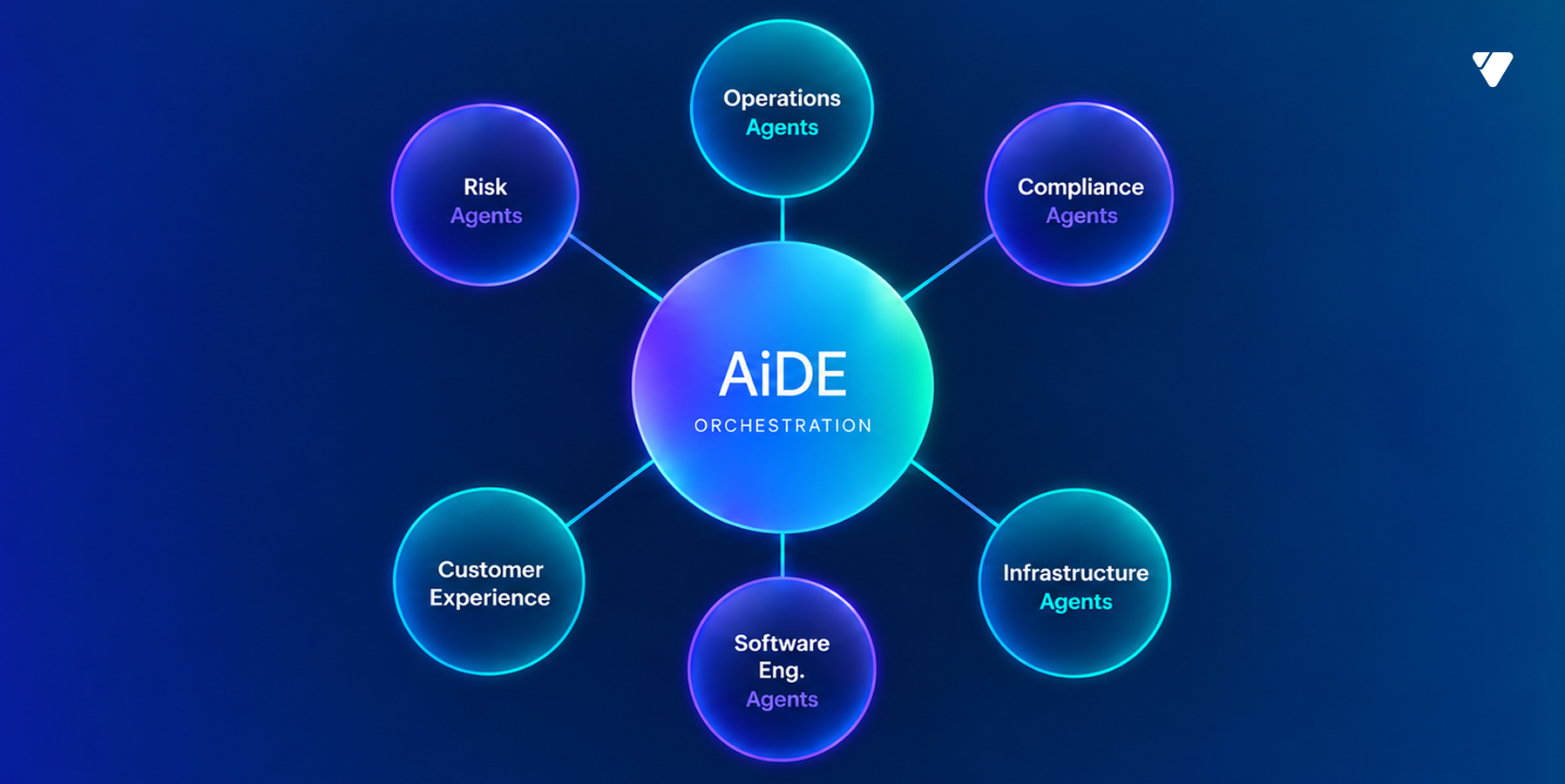
Optimize business processes end-to-end.
Validate regulatory obligations continuously.
Monitor and remediate IT environments.
04
SOFTWARE ENGINEERING AGENTS
Accelerate application delivery.
05
CUSTOMER EXPERIENCE AGENTS
Personalize every interaction.
Continuously assess operational exposure.
Governance Is the Foundation of Autonomy
For a regulated financial institution, autonomy without governance is not autonomy. It is exposure. Every autonomous decision must remain explainable, auditable, and aligned with enterprise policy, which is why governance is embedded into the architecture of AiDE® rather than layered on afterward.
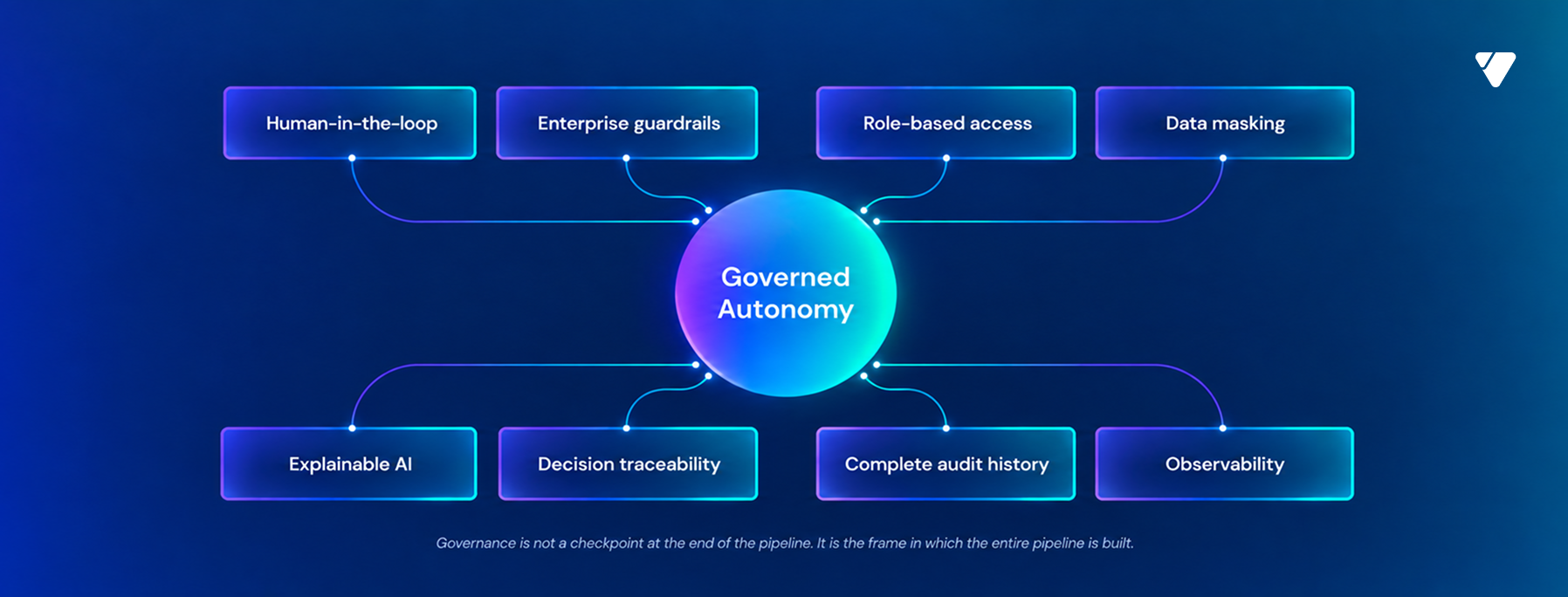
The bank determines where AI can recommend, where it can execute autonomously, and where human approval remains mandatory. The operating model remains fully aligned with the institution’s risk appetite and regulatory obligations at every step, not just at launch.
The Future Is an Autonomous Enterprise
Autonomous Banking is not about replacing people. It is about transforming how work gets done. Routine operational decisions become increasingly autonomous. Exceptions continue to be managed by experienced banking professionals, who now apply their judgment where it matters most, not on repetitive work that AI has already handled. AI augments institutional expertise. It does not stand in for it.
This is what enables banks to improve operational efficiency, reduce risk, accelerate service delivery, strengthen resilience, and enhance the customer experience, all while maintaining the governance standards that regulated institutions must uphold.
At ValueLabs, we believe the next competitive advantage in banking will not come from deploying another AI model. It will come from building an enterprise capable of orchestrating intelligence across every business function it runs. That takes more than generative AI. It takes an enterprise AI operating system.
Through AiDE®, ValueLabs is helping financial institutions move beyond isolated AI use cases toward an enterprise-wide operating model, one where intelligent agents collaborate securely, decisions remain transparent, governance is built into every workflow, and business operations become progressively autonomous.
Autonomous Banking is no longer a vision of the future. It is the next evolution of banking architecture. And at ValueLabs, we are helping banks build it.