Lessons from History's Most Infamous Breaches
The most expensive cybersecurity lesson is the one you pay for yourself. The second most expensive is ignoring what others already paid for.
These historic cyberattacks are not museum pieces. The root causes behind Heartbleed in 2014, WannaCry in 2017, SolarWinds in 2020, and MOVEit in 2023 are still present in enterprise environments today. The vulnerability classes have not disappeared. The exploitation patterns have not changed fundamentally. What has changed is the scale, sophistication, and business impact of each successive wave.
This article examines six landmark incidents: their technical root causes, how attackers exploited them, what they cost, and what they reveal about structural weaknesses that persist across the industry. The goal is not to retell familiar stories. It is to extract the strategic implications that CTOs, CISOs, and technology leaders can act on, and to examine why, despite decades of investment, enterprises keep encountering the same classes of failure.
Why Do History's Biggest Cyber Incidents Still Matter
A reasonable objection from any experienced leader is: we know about these incidents. The more useful question is whether enterprises have actually changed their behavior as a result.
The evidence suggests the answer is only partially yes. Verizon’s Data Breach Investigations Report continues to show that a large share of breaches involve exploited security vulnerabilities, stolen credentials, and phishing, the same mechanisms that drove most of the incidents here. The specific CVEs change. The underlying failure modes do not.
These incidents also remain relevant for a structural reason: the attack surface has expanded faster than security practices have matured. Cloud adoption, supply chain complexity, open source dependency sprawl, and connected systems have created an environment where a single unpatched library can expose thousands of downstream enterprises at once. That is not hypothetical.
For senior leaders, the value here is pattern recognition, not nostalgia. Understanding what failed, why, and at what cost provides a framework for judging whether your current posture would fare differently.
Assess Your Cyber Risk
See where your defenses stand against real threats.
At a Glance: Impact Across the Six Incidents
The table below summarizes the key facts for each incident before the detailed analysis.
| Incident |
Year |
Vulnerability type |
Systems or organizations affected |
Business impact |
Primary failure |
| Heartbleed |
2014 |
Memory safety flaw in OpenSSL |
500,000+ servers |
Severe reputational and credential damage |
Unaudited open-source dependency |
| WannaCry |
2017 |
Unpatched SMB vulnerability (EternalBlue) |
200,000+ systems, 150 countries |
$4B to $8B |
Delayed patch deployment |
| SolarWinds |
2020 |
Compromised software build pipeline |
~18,000 organizations |
Classified; widespread federal and enterprise impact |
No supply chain integrity verification |
| Log4Shell |
2021 |
Remote code execution in Apache Log4j |
Hundreds of millions of devices |
Billions in remediation costs globally |
Invisible transitive dependency |
| ProxyLogon |
2021 |
Zero-day chain in Microsoft Exchange |
~250,000 vulnerable Exchange servers |
Significant; ransomware and espionage follow-on |
Slow enterprise patch cycles |
| MOVEit |
2023 |
SQL injection in MOVEit Transfer |
2,700+ organizations, ~93M individuals |
Data theft and downstream exposure |
Vulnerability in a widely used third-party platform |
What Are History's Biggest Cyber Incidents?
Six incidents reshaped enterprise security: Heartbleed, WannaCry, SolarWinds, Log4Shell, MOVEit, and ProxyLogon. Below, we examine each for its root cause, exploitation method, and lasting lessons.
Heartbleed: When Open Source Trust Became a Liability
What happened: Heartbleed (CVE-2014-0160) was a buffer over-read flaw in OpenSSL, the library implementing TLS across much of the internet. It let an attacker read up to 64 kilobytes of server memory per request, repeatedly, without appearing in standard logs.
Root cause: A missing bounds check in the heartbeat handler let a malicious client request more data than it sent, and the server returned adjacent memory that could contain private keys, session tokens, or passwords.
Scale and impact: At disclosure, OpenSSL was estimated to secure approximately two-thirds of websites using TLS at the time. The flaw had existed in production since December 2011, meaning it was exploitable for roughly two years before discovery. Canada’s Revenue Agency confirmed theft of approximately 900 Social Insurance Numbers during the disclosure window.
What it revealed: A handful of underfunded volunteers maintained critical open-source infrastructure the global economy depended on. The Linux Foundation’s Core Infrastructure Initiative was a direct response.
Lessons that still apply: Maintain a complete software bill of materials including transitive dependencies; treat cryptographic library updates with OS-level urgency; make certificate and key rotation part of any TLS-related response.
WannaCry: The Ransomware That Exposed Patch Debt
What happened: WannaCry spread to about 200,000 systems across 150 countries within 72 hours, using EternalBlue, an NSA exploit leaked by the Shadow Brokers, that targeted SMBv1 on Windows (MS17-010).
Root cause: Microsoft had patched MS17-010 two months earlier. The worst-hit enterprises, including the UK’s NHS, ran unpatched or end-of-life systems. Because of the outbreak’s scale, Microsoft issued an emergency out-of-band patch for Windows XP.
Scale and impact: The NHS reported roughly 80 of 236 trusts affected, with 19,000 appointments canceled and ambulances diverted. Global damage estimates range from approximately $4 billion to $8 billion (treat as approximate). The US, UK, and Australia attributed WannaCry to North Korea’s Lazarus Group.
What it revealed: Patch debt is a quantifiable business risk, not merely technical hygiene. The gap between knowing and doing caused the damage. It also exposed the danger of retaining legacy protocols like SMBv1 out of inertia rather than necessity.
Lessons that still apply: Run patch management as a continuous function with defined SLAs; require explicit executive sign-off to retain legacy protocols; use segmentation to limit lateral movement. The accidental kill switch that halted WannaCry reminds us that external rescue is not a containment strategy.
SolarWinds: When a Trusted Vendor Became the Attack Vector
What happened: Attackers, attributed with high confidence to Russia’s SVR (APT29 / Cozy Bear), inserted a backdoor named SUNBURST into the build process of SolarWinds’ Orion platform. The trojanized, digitally signed updates reached approximately 18,000 customers through the normal update channel.
Root cause: The compromise sat in the build pipeline itself, so the malicious code carried a legitimate signature. SUNBURST lay dormant for about two weeks, then beaconed to command-and-control infrastructure using traffic designed to blend with legitimate Orion telemetry.
Scale and impact: Confirmed victims included the US Treasury, Commerce, Homeland Security, and State departments, plus FireEye (which discovered it) and Microsoft. Attackers moved laterally, forged SAML tokens, and reached cloud environments including Microsoft 365.
What it revealed: A signed update from a known vendor could no longer be treated as inherently safe. It also exposed the limits of network-centric defense, since SUNBURST hid inside legitimate-looking traffic.
Lessons that still apply: Treat zero trust as a design principle that assumes any component may be compromised; assess vendor build pipeline integrity, not just certifications; give SAML and identity federation the same scrutiny as the perimeter; rely on behavioral analytics, not signatures alone, to catch sophisticated actors.
Log4Shell: One Library, a Global Crisis
What happened: Log4Shell (CVE-2021-44228) was a remote code execution flaw in Apache Log4j 2, a Java logging library embedded across enterprise software. An attacker could trigger execution simply by logging a crafted string.
Root cause: Log4j’s JNDI lookup feature resolved user-controlled input without sanitization. A string such as $ placed in any logged field, including HTTP headers or usernames, caused the server to fetch and run a remote payload.
Scale and impact: CISA described it as one of the most serious vulnerabilities it had seen. Log4j was buried deep in products from Apple, Amazon, Cisco, IBM, VMware, and hundreds of others. Exploitation began within hours; nation-state actors from China, Iran, North Korea, and Russia were observed within days per Microsoft’s reporting.
What it revealed: The core problem was not that Log4j had a flaw. The problem was that most enterprises had no systematic way to know where it existed. You cannot patch what you cannot find. It also exposed the compounding risk of transitive dependencies.
Lessons that still apply: Integrate software composition analysis into CI/CD rather than applying it during incidents; make SBOM generation a procurement requirement; treat dynamic resolution features like JNDI as an attack surface; build the ability to search the entire estate rapidly.
MOVEit: Supply Chain Exploitation at Industrial Scale
What happened: The Cl0p ransomware group exploited a zero-day SQL injection vulnerability (CVE-2023-34362) in Progress Software’s MOVEit Transfer, a widely used managed file transfer platform. Attackers used the vulnerability to gain access to MOVEit environments and exfiltrate data before and around the time the vulnerability was publicly disclosed and patched.
Root cause: The SQL injection vulnerability in MOVEit’s web application layer let attackers gain unauthorized access and deploy a web shell, giving them persistent access to affected environments and enabling large-scale data theft.
Scale and impact: More than 2,700 organizations and approximately 93 million individuals were ultimately affected, making it one of the largest data-theft campaigns by victim count.
What it revealed: The supply-chain attack surface extends beyond software build pipelines to third-party infrastructure that concentrates sensitive data. A file-transfer platform is, by design, a concentration point. Organizations can therefore inherit significant exposure from a vulnerability in a vendor product even when their own systems have not been directly compromised.
Lessons that still apply: Assess what data flows through vendor systems, not just whether a vendor holds a security certification; apply additional monitoring and access controls to file-transfer and data-exchange infrastructure; minimize the amount of sensitive data exposed through third parties; and build downstream notification and response procedures into the incident-response plan when vendors process data on behalf of customers.
Microsoft Exchange ProxyLogon: When the Front Door Was Left Open
What happened: ProxyLogon (CVE-2021-26855), chained with three further flaws (CVE-2021-26857, CVE-2021-26858, CVE-2021-27065), let an unauthenticated attacker achieve remote code execution on any internet-facing Exchange server. Microsoft attributed the initial exploitation to the Chinese state-sponsored group HAFNIUM, but within days, at least ten distinct groups exploited the same chain.
Root cause: A flaw in Exchange’s authentication proxy let a crafted HTTP request be processed as if it came from a trusted internal source, bypassing authentication. The chained flaws then allowed arbitrary file writes, enabling web shell deployment for persistent access.
Scale and impact: Security researchers estimated that approximately 250,000 Exchange servers were exposed during the early phase of exploitation. Because Exchange was widely deployed on-premises and internet-facing, the attack surface was enormous. Victims spanned defense contractors, law firms, researchers, and local government.
What it revealed: Internet-facing authentication and email systems are among the highest-value targets, yet often the slowest to patch because of fears of disruption, creating the very risk caution is meant to avoid. It also showed how quickly a disclosed flaw moves from nation-state to commodity criminal exploitation, making the “we are not a nation-state target” assumption irrelevant.
Lessons that still apply: Apply an accelerated patching SLA to internet-facing authentication infrastructure, measured in hours to days; make web shell detection standard on such systems; recognize that cloud migration eliminates a class of self-managed patching risk while introducing its own controls; evaluate vulnerability chains, not just individual CVE scores.
What Patterns Do These Cyberattacks Share
Examined together, these six incidents reveal recurring failure modes that transcend any single vulnerability or actor.
How Cyber Threats Have Evolved
The table below traces how the primary attack pattern has shifted by era, providing context for the patterns discussed below.
| Era |
Primary Attack Pattern |
| 2010–2015 |
Software vulnerabilities |
| 2015–2020 |
Ransomware and supply chain attacks |
| 2020–2025 |
Identity, cloud, and third-party compromise |
| 2025+ |
Emerging trends include AI-enabled attacks and automated exploitation. |
Five patterns explain how these shifts played out across the six incidents examined here.
- The patch gap is where damage accumulates. WannaCry, ProxyLogon, and MOVEit all involved flaws with available or quickly released patches. The damage occurred between availability and deployment. That interval is organizational, not technical.
- Sophisticated actors prefer trusted components. SolarWinds, Log4Shell, and MOVEit all exploited trust: in a signed update, a ubiquitous library, a certified platform. As perimeter defenses have matured, attackers have increasingly targeted trusted components, software suppliers, and third-party infrastructure.
- Visibility gaps precede containment failures. The worst outcomes shared one trait: enterprises did not know what they were running. They could not locate Log4j or SMBv1, or see what flowed through MOVEit. You cannot protect what you cannot see.
- Detection lag amplifies impact. Heartbleed was exploitable for roughly two years before disclosure; SUNBURST beaconed for months before FireEye caught it. Mean time to detect remains one of the most consequential metrics in security operations.
- Response maturity is not evenly distributed. Enterprises with defined playbooks and pre-established communication channels contained incidents faster. Those without them improvised under pressure, the worst possible condition for good decisions.
What Security Controls Could Have Prevented These Attacks?
No single control prevents every incident, but the answer reveals whether your current posture would fare differently.
- For vulnerability exploitation (WannaCry, ProxyLogon, Log4Shell, MOVEit): continuous, asset-complete vulnerability scanning; risk-tiered patch management with accelerated SLAs for internet-facing systems; network segmentation to limit lateral movement; software composition analysis in CI/CD; SBOM generation for all production systems.
- For supply chain compromise (SolarWinds, MOVEit): vendor assessments that verify build pipeline integrity, not just certifications; behavioral network anomaly detection, especially for systems that communicate externally by design; privileged access management limiting what a compromised vendor tool can reach; data flow mapping across vendor systems.
- For detection and response (all incidents): SIEM with behavioral analytics, not only rule-based alerting; tested incident response playbooks per threat category; mean time to detect and respond tracked as leadership-level KPIs; threat intelligence integration for early warning of active campaigns.
The honest observation: defense in depth, layering controls so any single failure is not catastrophic, remains the most reliable principle. What has changed is the sophistication required at each layer.
Cut Your Mean Time to Detect Threats with AI-driven Security
AiDE Shield analyzes security data across cloud and on-prem environments to help you catch threats earlier.
How Have Major Cyber Incidents Changed Cybersecurity Practices?
Each incident produced measurable shifts that now define the baseline against which your program is judged.
- Heartbleed accelerated investment in open-source security initiatives, ultimately contributing to broader ecosystem efforts such as the Linux Foundation’s Core Infrastructure Initiative and later OpenSSF programs, and making SBOMs and security scorecards increasingly standard in procurement.
- WannaCry drove regulatory attention to healthcare cybersecurity and accelerated the retirement of Windows XP across public sector enterprises.
- SolarWinds catalyzed zero trust adoption at the federal level. The US Executive Order 14028 (May 2021) referenced the incident directly and introduced SBOM requirements for software sold to the government, which has since influenced commercial procurement.
- Log4Shell made SBOM a mainstream enterprise requirement, because the inability to locate one library across an estate made the business case self-evident to boards.
- MOVEit intensified regulatory scrutiny of third-party data processors, with downstream victims facing scrutiny for failing to assess their providers.
- ProxyLogon reinforced the security trade-offs of self-managed, internet-facing infrastructure, highlighting the patching burden and attack surface that organizations must manage with on-premises deployments.
What Should Enterprise Leaders Consider for Cyber Resilience
Cyber resilience is the operational core of cyber risk management: the capacity to anticipate, withstand, respond to, and recover from incidents without catastrophic disruption. It differs from cybersecurity in one crucial way: it assumes some incidents will succeed and builds the organizational muscle to absorb them. Five areas deserve focused attention.
- Asset and dependency visibility as a foundation: You cannot manage risk across assets you cannot enumerate, across hardware, software, cloud services, open source dependencies, and third-party data flows. The enterprises that handled Log4Shell and MOVEit best could query their inventory and get a reliable answer in hours. That capability is the prerequisite for almost everything else.
- Patch management as a risk function, not IT maintenance: Govern patching with risk-tiered SLAs and explicit escalation when a critical patch cannot be applied in time. Internet-facing critical vulnerabilities warrant hours to days; internal medium-severity issues can wait longer. Operationalize the distinction, not just document it.
- Supply chain security as a continuous program: Annual questionnaires are insufficient. This requires continuous monitoring of vendor posture, contractual security and breach-notification terms, and architecture that limits blast radius. Least privilege applies to vendor access as it does to internal users.
- Detection and response as a strategic investment: Detection lag is the primary amplifier of damage. Whether through an internal SOC, a managed detection and response provider, AI incident response tooling, or a combination, reducing time to detect is among the highest-return security investments available.
- Incident response preparedness as a board-level concern: Decisions during a major incident, around disclosure, continuity, regulatory notification, and communication, require executive involvement. Enterprises that rehearse through tabletop exercises, including supply chain and ransomware scenarios, consistently outperform those that do not.
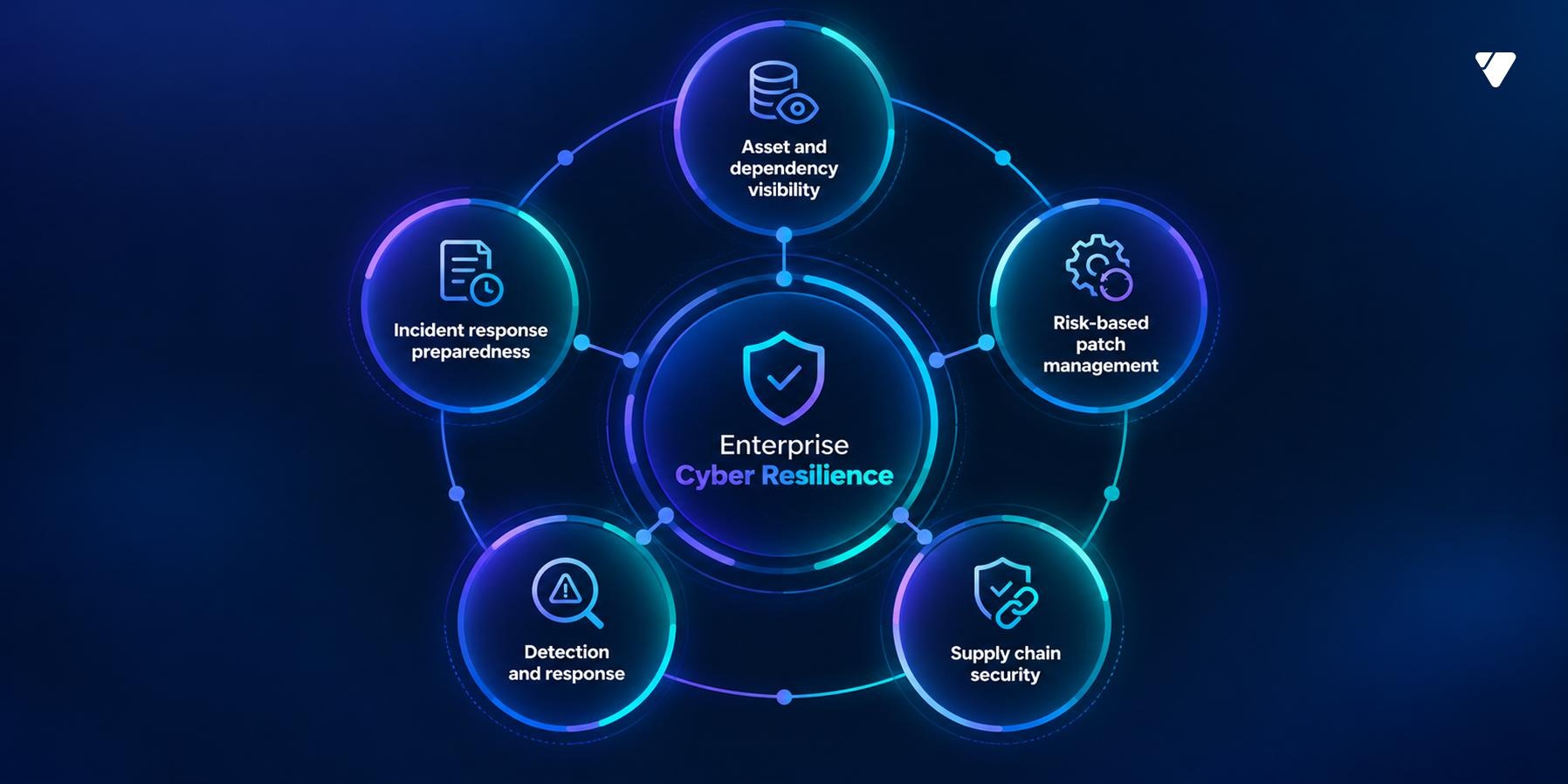
The incidents that caused the most damage were rarely the most sophisticated. They succeeded because enterprises lacked visibility, delayed patching, or trusted vendors without verifying. Closing those gaps takes more than tools. It takes a structured program that connects asset intelligence, supply chain risk, and detection capabilities.
Explore ValueLabs’ cybersecurity services or speak with our experts about your current exposure across the threat classes discussed here.
How Does ValueLabs Help Build Enterprise Cyber Resilience
These incidents share a common thread: they exploited gaps in visibility, response speed, and trust verification that most enterprises had not systematically addressed. ValueLabs cybersecurity practice is built to close exactly those gaps.
- Threat detection and AI-augmented analytics. ValueLabs applies AI-driven threat detection and AI security analytics to reduce mean time to detect. Behavioral and machine learning models surface anomalies that signature-based tools miss, exactly what’s needed to catch SUNBURST’s unusual traffic or ProxyLogon web shell activity earlier. AiDE Shield, ValueLabs’ cybersecurity monitoring solution, sits within AiDE® (AI Driven Everything), ValueLabs’ Agentic AI platform, and is built for this. It collects and analyzes security data across cloud and on-premises environments to eliminate blind spots, applies machine-learning anomaly detection to identify threats, and triggers automated alerts so security teams can respond quickly.
- Vulnerability intelligence and patch management: ValueLabs helps operationalize risk-tiered patch programs that prioritize remediation by asset criticality, exposure, and active exploitation, directly addressing the patch gap behind WannaCry and ProxyLogon.
- Supply chain security assessments: Given the trajectory from SolarWinds to MOVEit, ValueLabs offers structured assessments that go beyond questionnaires to examine build pipeline integrity, data flow exposure, and the architectural controls that limit blast radius when a vendor is compromised.
- Incident response planning: ValueLabs helps develop and test playbooks across ransomware, supply chain compromise, and zero-day exploitation, including tabletop exercises that stress-test executive decision-making, not only technical response.
- Security awareness training: AiDE Aware is ValueLabs’ security-awareness platform, helping enterprises run simulated phishing and social-engineering campaigns and deliver personalized training to employees. Since stolen credentials and phishing remain leading breach vectors industry-wide, closing this human-layer gap complements the technical controls above.
The common principle: resilience is built through visibility, speed, and verification, not through any single tool. ValueLabs’ role is to help assemble these capabilities into a coherent program that fits an enterprise’s environment, risk tolerance, and operational constraints.
Conclusion
The most uncomfortable takeaway from studying history’s biggest cyber incidents is how few required novel attacker capability. Most exploited weaknesses were known, documented, and, in several cases, patched. The failure wasn’t failing to anticipate the unknown. It was failing to act on what was known.
That reframes the strategic question for leaders. The relevant issue is rarely whether a new threat class will emerge, though it will. It is whether your enterprise has the visibility to know what it runs, the discipline to remediate known risks in a defensible timeframe, the architecture to limit blast radius when a trusted component is compromised, and the detection maturity to catch an intrusion before it becomes a catastrophe.
The enterprises that weathered these incidents best were not the ones with the largest budgets. They turned fundamentals into operational habits: complete asset inventories, risk-tiered patching, behavioral detection, and tested response plans. None of these are exotic. All are difficult to sustain at enterprise scale, which is why so many enterprises don’t.
The lesson from every incident here is the same, expressed in different technical vocabulary each time. Know what you run. Patch what matters, quickly. Do not extend trust without verification. Detect early, respond faster. The attackers have industrialized their methods. The defensive response must be equally systematic.