Why Does Software Supply Chain Risk Escape Traditional Security Controls?
Software supply chain risk escapes traditional security controls because enterprises often assess the vendor without continuously validating the software and components that vendor delivers. In 2020, attackers compromised SolarWinds’ build environment and embedded malicious code into a digitally signed software update. Thousands of organizations installed it because every trust signal indicated legitimacy. The vendor had passed the assessments. The code did not.
The attack surface now extends below the vendor relationship into dependencies, build pipelines, update mechanisms, and AI components. The question is no longer simply whether a supplier is secure, but whether what enters your environment remains trustworthy.
Why Vendor Risk Management Is No Longer Enough?
Vendor risk management assesses organizations. Software supply chain security assesses the artifacts, code, dependencies, and processes you actually run. The two disciplines address different risks and treating them as interchangeable creates a blind spot.
Traditional third-party risk management relies on point-in-time controls:
- Security questionnaires
- Contractual clauses
- SOC 2 attestations
- Procurement gates
These evaluate a company’s posture on the day you sign. But your real exposure is rarely the vendor you contracted with. It is your vendor’s vendor, and the open-source component six dependency layers deep that no one signed anything for.
What is the difference between vendor risk and software supply chain risk?
Vendor cyber risk is a snapshot of a business relationship. Software supply chain risk is continuous, transitive, and often invisible to the people who approved the vendor.
| Dimension |
Vendor Cyber Risk |
Software Supply Chain Risk |
| What it assesses |
The organization you contract with |
The artifacts, code, and dependencies you actually run. |
| Timing |
Point-in-time snapshot |
Continuous and ongoing. |
| Scope |
The direct vendor relationship |
Transitive, extending to your vendor’s vendors and deep dependencies. |
| Visibility |
Known to procurement and security |
Often invisible to the people who approved the vendor. |
| Primary control |
Questionnaires, contracts, SOC 2 attestations |
Provenance verification, integrity checks, and runtime monitoring. |
| Typical blind spot |
Choosing an insecure vendor |
Passing every vendor audit and still shipping compromised code. |
How Do Software Supply Chain Attacks Happen?
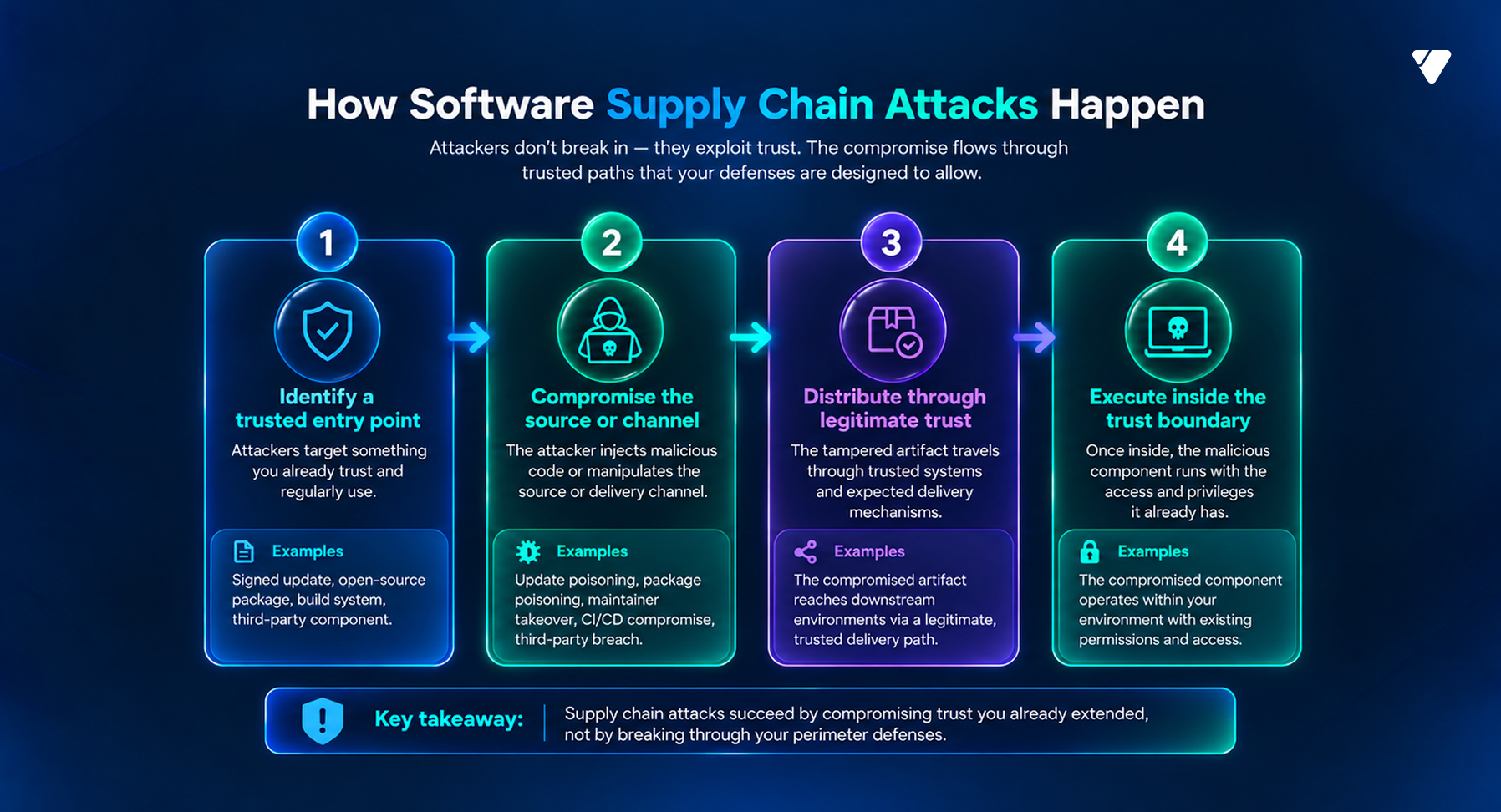
Software supply chain attacks work by compromising something you already trust and install, rather than breaching your perimeter directly. If your defenses are configured to accept the payload, the attacker never has to get past them. The attack follows a repeatable pattern:
- Identify a trusted entry point: a signed update, open-source package, build system, or third-party component.
- Compromise the source or channel: through update poisoning, package poisoning, maintainer takeover, CI/CD compromise, or a third-party breach.
- Distribute through legitimate trust: the tampered artifact reaches downstream environments through an expected delivery path.
- Execute inside the trust boundary: the compromised component operates with the access it already has.
The Biggest Software Supply Chain Security Risks Leaders Underestimate
The most dangerous software supply chain risks are the ones that never appear in a procurement review. They are structural, not contractual.
Four structural risks stand out:
- Transitive dependency blindness
- Weak provenance and integrity verification
- Gaps in continuous monitoring
- Regulatory exposure
Enterprises may lack a reliable map of what their software contains, cannot always prove an artifact is authentic, reassess third-party risk less frequently than the environment changes, and ultimately inherit compliance and reputational consequences when a dependency fails.
This is where SBOM becomes useful.
Is Your Supply Chain Truly Secure?
Go beyond vendor risk. Secure what you actually run.
What is an SBOM and Why is it is it Important?
An SBOM, or Software Bill of Materials, is an inventory of the components inside a piece of software. It matters because it provides the visibility that supply chain security frameworks and transparency requirements increasingly demand. But an inventory is not a control. Knowing what you have does not mean you are verifying its integrity or monitoring its behavior. SBOM is a starting point for software integrity, not a destination.
How does SBOM improve software supply chain security?
An SBOM improves software supply chain security by giving you a complete, verifiable inventory of every component and transitive dependency in your software. When a vulnerability surfaces, you know immediately which systems are affected. It provides the visibility that continuous software supply chain risk management depends on.
How Does AI Change Software Supply Chain Security?
AI extends software supply chain risk beyond code and packages to models, training data, embeddings, plugins, and agent tool-chains. Traditional controls may not establish where these assets originated, whether they were altered, or what risks they introduce into production systems.
Model provenance and poisoning create governance questions that traditional software controls do not fully address:
‘Where did these model weights come from, and can you verify that they were not tampered with?’
AI dependency risk treats foundation models, embeddings, plugins, and agent tool-chains as a supply chain feeding production systems. AI vendor governance therefore extends beyond conventional SaaS review to model provenance, data integrity, and the behavior of systems that can produce probabilistic outputs.
How Is Agentic AI Reshaping Software Supply Chain Security?
Agentic systems add another dimension. When AI does not just inform decisions but takes action, a compromised dependency inherits execution rights. That turns the supply chain from a passive attack surface into an active one, dramatically expanding blast radius. For enterprises building on agentic architectures, this is not a future concern.
What Should a Software Supply Chain Security Framework Include?
Effective supply chain cybersecurity is continuous, evidence-based, and extends from code commit to runtime. It is not a procurement checkbox. Four pillars hold it together.
- Visibility means maintaining a live inventory with provenance across software and AI assets.
- Verification means using integrity controls and hardened build pipelines so tampered artifacts cannot pass as trusted.
- Continuous monitoring replaces point-in-time attestation with behavioral detection when trusted components change.
- Response assumes compromise is possible and limits the blast radius when it occurs.
AiDE® is ValueLabs’ proprietary Agentic AI platform for enterprise AI-driven engineering and operations. Within it, AiDE Shield provides XDR capabilities for real-time threat detection, threat hunting, and incident response. For software supply chain security, its role is specific: when a trusted component begins behaving maliciously, detection must happen at the behavior level, not the trust level. provides XDR capabilities for real-time threat detection, threat hunting, and incident response. For software supply chain security, its role is specific: when a trusted component begins behaving maliciously, detection must happen at the behavior level, not the trust level.
Your Vendor Passed the Audit. But Is Your Software Supply Chain Secure?
Build continuous visibility, verification, monitoring, and response across the software and AI assets you run.
How ValueLabs Can Help?
Supply chain security requires continuous verification across software, dependencies, cloud environments, and AI systems, not a stricter vendor questionnaire. ValueLabs helps enterprises strengthen cybersecurity across interconnected digital ecosystems, combining cybersecurity services with AI-driven capabilities to improve threat detection, response, compliance readiness, and operational resilience.
For organizations reassessing how far their supply chain visibility reaches, the priority is clear: know what you run, verify what you trust, and monitor what you cannot fully control.
Conclusion
The lesson underneath every major incident is the same: trust is not a control. Supply chain security fails when leaders treat it as an extension of vendor risk management, because the risk lives in the artifacts, dependencies, and models they run, not the contracts they sign. As AI makes that surface increasingly active, point-in-time reviews cannot keep pace. Resilient organizations continuously verify what they run, monitor how trusted components behave, and prepare to contain compromise.