Why Enterprise Quality Engineering Needs a New Operating Model
Enterprise Quality Engineering needs a new operating model because traditional QA approaches are no longer sufficient for the complexity, speed, and interconnectedness of modern software delivery.
Many legacy QA operating models evolved around sequential delivery, comparatively monolithic applications, and less frequent release cycles. Enterprise software now operates across cloud-native services, APIs, event-driven architectures, third-party dependencies, AI-enabled components, and continuous delivery. That complexity makes functional validation alone insufficient for a complete view of release risk.
Quality engineering is therefore expanding beyond executing test cases and maintaining automation scripts. Modern QE must help connect functional validation with security, performance, resilience, accessibility, compliance, AI-system assurance, operational readiness, and production feedback. The objective is not simply to prove that a set of scenarios have passed. It is to provide evidence that the software can deliver intended business outcomes within acceptable risk.
Questions enterprise leaders actually need answered
- Can this release sustain expected and peak business demand?
- Have the most critical customer and revenue journeys been validated?
- Are security and privacy controls operating as intended?
- Will AI-enabled features behave reliably within defined business guardrails?
- Can the system tolerate dependency or infrastructure failures?
- Do we have the telemetry and operational controls needed to detect and respond to failures quickly?
- What residual risks remain, and are they acceptable for this release?
A regression pass rate is useful evidence for some of these questions, but it cannot answer all of them. That is why modern QE is moving toward continuous assurance across the software lifecycle.
Why Traditional Pre-Release Testing is Insufficient for Modern Systems?
Testing remains necessary. What has changed is the testing environment. Distributed systems introduce failure modes that are difficult to reproduce through isolated, pre-release test execution alone.
- Cloud-native microservices and distributed APIs
- Event-driven architectures and asynchronous workflows
- Third-party and partner integrations
- AI-powered decision engines and agents
- Multi-cloud and edge infrastructure
- Continuous deployment and feature-release mechanisms
The response is not a new label for testing. It is a broader set of engineering practices: continuous testing, shift-left quality engineering, security testing within DevSecOps, performance and resilience engineering, test data management, observability-driven validation, and disciplined production feedback.
Don’t Wait for Release Risk to Expose Gaps in Your Quality Engineering
Build a risk-based QE strategy with AI, automation, and continuous assurance tailored to your enterprise.
Automation Coverage is Useful – But it is Not Business-Risk Coverage
Automation has transformed software delivery. Frameworks such as Selenium, Playwright, Cypress, and Appium have reduced repetitive manual execution and made faster regression testing possible. The problem is not automation. The problem is treating automation percentage as a proxy for production readiness.
A team can automate a large percentage of its regression suite while still missing the scenarios with the greatest financial, operational, customer, or regulatory impact. High automation coverage therefore indicates efficiency and breadth of scripted validation, not the absence of material release risk.
| Metric |
What it measures |
What it does not prove |
| Automation coverage |
How much of the eligible test scope is automated |
That the highest-risk scenarios are covered |
| Requirements / feature coverage |
How many requirements or features have validation mapped |
That validation is deep enough or operationally realistic |
| Code coverage |
Statements, branches, or functions exercised by tests |
That business outcomes, integrations, or user journeys are correct |
| Journey coverage |
Critical end-to-end business journeys exercised |
That non-functional and production risks are controlled |
| Risk coverage |
Identified business/technical risks with evidence of validation |
That every residual risk is acceptable without governance review |
The useful question is not ‘What percentage is automated?’ It is ‘What does the automated coverage protect, and what material risk remains outside it?’
From Test Execution to Continuous Assurance
| Dimension |
Test execution |
Continuous assurance |
| Primary question |
Did the defined scenario behave as expected? |
Is the residual release risk acceptable? |
| Evidence |
Test results and defects |
Multi-disciplinary quality and operational evidence |
| Scope |
Defined functional and non-functional validation |
Functional, security, performance, resilience, compliance, AI, and operational readiness |
| Timing |
During planned validation activities |
Across build, test, deploy, operate, and learn |
| Ownership |
Execution can be QE-led or engineering-led |
Cross-functional; product and engineering remain accountable for release risk |
| Decision support |
Contributes evidence |
Supports transparent, risk-informed release decisions |
What We Mean by Assurance Orchestration?
Assurance orchestration refers to an operating model that coordinates quality evidence from multiple engineering disciplines into a continuous view of software readiness. It is not a replacement for testing or a single product. Instead, it provides a way to structure evidence, ownership, governance, and feedback so release decisions consider a broader set of signals than isolated pass/fail results.
Assurance orchestration = multiple quality disciplines + shared evidence + explicit risk thresholds + continuous feedback + accountable release decisions.
The Quality Signals that Contribute to Assurance
| Quality dimension |
Role in the assurance model |
| Functional testing |
Confirms expected behavior across features, APIs, integrations, and critical journeys. |
| Security and privacy |
Identifies vulnerabilities, control failures, data-exposure risks, and policy violations. |
| Performance engineering |
Assesses response time, throughput, scalability, and capacity under representative workloads. |
| Reliability and resilience |
Assesses fault tolerance, recoverability, dependency failure, graceful degradation, and service reliability. |
| Accessibility |
Assesses conformance with applicable accessibility standards and supports inclusive user experiences. |
| Compliance evidence |
Provides traceable validation evidence against applicable regulatory and organizational requirements. |
| AI-system assurance |
Evaluates reliability, groundedness/correctness, robustness, safety, security, privacy, bias where relevant, drift, and adherence to business guardrails. |
| Business risk |
Connects quality findings to customer, revenue, operational, legal, and reputational impact. |
| Observability and operational health |
Uses logs, metrics, traces, SLOs, user behavior, and incident data to understand real-world system behavior and feed learning back into QE. |
From Isolated Gates to Continuous Evidence
Quality gates still matter, especially for non-negotiable security, compliance, safety, privacy, and reliability conditions. The shift is that gates should not be the only place where quality is evaluated. Evidence should accumulate throughout development, deployment, and operation, with critical thresholds enforced automatically where appropriate and exceptions routed through explicit human governance.
How AI is Changing Quality Engineering
AI is increasing the speed and breadth of many engineering activities, but the value is not simply “more automation.” The opportunity is to improve how teams identify risk, generate and maintain validation, analyze failures, and prioritize scarce engineering attention.
The 2025 DORA research, based on nearly 5,000 technology professionals, reported that 90% of respondents use AI at work, more than 80% believe it has increased their productivity, and 59% reported a positive impact on code quality. DORA also emphasizes that AI acts as an amplifier: organizations gain more when strong engineering systems, platforms, feedback loops, and governance already exist.
AI for QE and AI-system Assurance are Different
| AI for QE |
AI-system assurance |
| Generate and refine test scenarios |
Evaluate correctness, groundedness, and task success |
| Prioritize regression using change, risk, and usage signals |
Evaluate robustness, safety, and adversarial behavior |
| Analyze defects, failures, logs, and historical patterns |
Evaluate security, privacy, permissions, and tool-use boundaries |
| Assist with test maintenance and self-healing |
Evaluate bias/fairness where relevant and policy adherence |
| Generate/provision test data within governance controls |
Monitor model/data/behavior drift and changing risk |
| Summarize quality evidence for human review |
Validate escalation, human override, and action traceability for agents |
Where AI Adds Practical Value in QE
AI adds practical value to QE by reducing manual effort, improving risk-based coverage, and turning fragmented quality signals into actionable insights.
- Test design: generate candidate scenarios from requirements, user stories, APIs, code changes, and production evidence.
- Impact-based testing: identify potentially affected areas and prioritize regression based on change and risk.
- Defect intelligence: cluster failures, suggest likely root causes, and correlate defects with code, configuration, environment, or data changes.
- Test maintenance: detect brittle automation and propose safe repairs with reviewable evidence.
- Test data: synthesize, provision, and manage fit-for-purpose data while enforcing privacy and compliance controls.
- Quality intelligence: correlate test, defect, security, performance, and operational signals to help humans make faster decisions.
Governed Autonomy is the Practical Enterprise Model
For many enterprise environments, Governed autonomy is currently the more practical adoption model. AI can generate, prioritize, execute, analyze, and recommend; humans and accountable engineering leaders retain control over policies, exceptions, and consequential release decisions.
Gartner reported in May 2025 that 71% of surveyed engineering leaders considered the use of AI tools to augment software engineering workflows a significant or moderate pain point. That reinforces a simple lesson: adoption depends as much on workflow integration, governance, data, and trust as on model capability.
- Traceable inputs, prompts, tool calls, and outputs
- Human-defined policy and risk thresholds
- Approval or escalation for consequential actions
- Auditability and reproducibility of evidence
- Human override and exception handling
- Ongoing monitoring for drift and unintended behavior
Release Confidence Should be a Decision Model – Not a Magic Percentage
Release confidence is a useful way to frame software readiness because it asks a more meaningful question than ’Did the tests pass?’ The concept becomes dangerous, however, if organizations compress every signal into one averaged number and let strong results in one area to mask a failed critical control in another.
A stronger approach is a release-confidence scorecard: a structured view of quality evidence, mandatory gates, residual risk, and trend information. A numerical score can be included for communication, but it should never override a failed hard gate or unresolved material risk.
| Signal |
Example evidence |
Decision treatment |
| Business-critical journeys |
Risk-weighted journey coverage, defect status, acceptance evidence |
Weighted evidence; critical journey failures may block release |
| Functional quality |
Regression results, API/integration evidence, defect severity |
Weighted evidence with severity rules |
| Security/privacy |
SAST/DAST findings, control checks, privacy risks |
Hard gates for defined critical conditions |
| Performance/capacity |
Latency, throughput, saturation, load/stress evidence |
Threshold-based; critical breaches block or require explicit exception |
| Reliability/resilience |
Failover, recovery, dependency-failure, SLO/error-budget evidence |
Threshold-based and risk-reviewed |
| Compliance |
Required control evidence and traceability |
Hard gates where regulation/policy requires |
| AI-system assurance |
Reliability, safety, guardrail, permissions, drift, evaluation results |
Policy-based thresholds and human approval for consequential behavior |
| Operational readiness |
Observability, alerting, rollback, runbooks, support readiness |
Required readiness criteria |
| Known residual risk |
Accepted defects, exceptions, mitigation plans, owners |
Explicit documented acceptance by accountable owners |
Release decisions should be evidence-informed, risk-based, and traceable – not judgment-free. Human judgment remains essential for interpreting residual risk and business trade-offs.
Observability Closes the Loop Between Testing and Production
Pre-production testing is essential but inherently incomplete. Production exposes real users, real workloads, real dependency behavior, and usage patterns that cannot bestaging cannot fully reproduce. Production should therefore be treated as the ultimate source of operational truth – not as a substitute for disciplined pre-production validation.
Observability provides the telemetry and diagnostic context needed to extend assurance into production and feed real-world behavior back into quality engineering. OpenTelemetry describes observability as the ability to understand a system from its emitted signals, including traces, metrics, and logs.
| Production signal |
Contribution to quality engineering |
| Logs |
Reveal recurring application errors, unexpected states, and failure patterns. |
| Metrics |
Show latency, availability, throughput, saturation, error rate, and resource trends. |
| Traces |
Expose cross-service bottlenecks, dependency failures, and transaction paths in distributed systems. |
| SLOs / error budgets |
Connect technical reliability to user expectations and agreed service objectives. |
| Real user and journey data |
Highlights friction, abandonment, low-frequency paths, and changing usage patterns. |
| Incidents and support signals |
Reveal failure modes that should influence future tests, controls, and resilience scenarios. |
The objective is not to discover defects in production by design. It is to learn from production systematically so future validation becomes better aligned with real-world risk.
Your Release Velocity Is Only as Strong as Your Quality Engineering
Strengthen release confidence with AI-powered QE, connected quality signals, and enterprise-grade assurance.
Quality Remains Cross-Functional: Who Contributes What?
Assurance orchestration should not make QE the owner of every quality discipline. The model works when evidence is produced by the teams closest to each risk and then brought together through shared standards, tooling, governance, and decision forums.
| Function / capability |
Primary contribution to assurance |
| Product and engineering |
Own product outcomes, engineering quality, technical decisions, and acceptance of release risk. |
| Quality engineering |
Designs risk-based validation, orchestrates/consumes quality evidence, provides reusable QE capabilities, and challenges gaps in assurance. |
| Security / DevSecOps |
Defines security policies and risk thresholds; produces security evidence and remediation guidance. |
| Platform / DevOps capabilities |
Provide CI/CD, environments, deployment controls, infrastructure automation, and shared engineering platforms. |
| SRE / reliability engineering |
Contributes SLOs, reliability objectives, incident learning, resilience practices, and operational evidence. |
| Data / AI engineering and AI governance |
Provide model/data controls, evaluation requirements, monitoring, and AI-system governance. |
| Business / compliance stakeholders |
Define material business risk, regulatory obligations, acceptance criteria, and exceptions where applicable. |
In mature organizations, release governance uses this combined evidence rather than asking QE alone to “sign off” quality. QE becomes a key orchestrator and interpreter of quality intelligence, while accountability for product quality stays with the teams that build and operate the product.
How Enterprises can Modernize Quality Engineering?
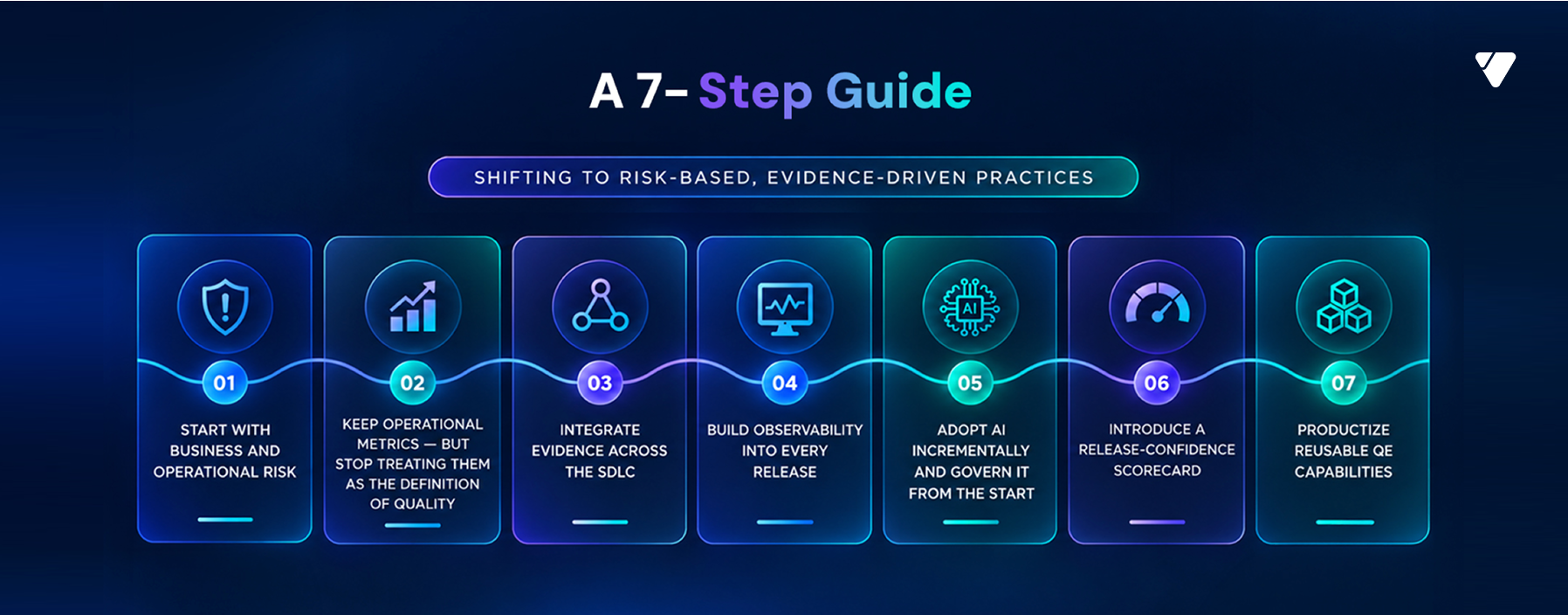
Enterprises can modernize quality engineering by shifting from test-centric delivery to risk-based, evidence-driven quality practices.
How ValueLabs Operationalizes the Model
ValueLabs combines quality engineering services, reusable QE capabilities, AiDE®, and cross-functional engineering through its OneCompany® approach. The objective is to reduce fragmented project execution and help teams connect automation, data, AI, observability, and governance into a more coherent assurance model.
Selected ValueLabs Engagement Outcomes
The following figures are based on ValueLabs engagement data for anonymized clients.
| Engagement |
What changed |
Reported outcome |
| Major airline cloud/data modernization |
Reusable, parameter-driven data validation across databases, files, messaging, and services |
15M+ records validated monthly; 33% less scripting effort; 35+ applications supported |
| Major U.S. airline chatbot validation |
AI-assisted validation expanded automated coverage and reduced repetitive QA effort |
90% less QA effort; 80% faster validation cycles; 3-4x functional coverage |
| Major U.S. airline test-data provisioning |
AiDE®-powered provisioning reduced environment/data setup effort |
Setup reduced from weeks to approximately 30-60 minutes |
AiDE® in the Assurance Model
AiDE®, ValueLabs’ proprietary agentic AI platform, supports use cases such as test authoring, impact-based testing, execution, defect analysis, self-healing, test data, and continuous quality intelligence. In an assurance-orchestration model, these capabilities should remain observable and governed: AI accelerates evidence generation and analysis, while accountable humans retain control over consequential quality and release decisions.
To Bring it All Together
Quality engineering in 2026 is not defined by how many tests an organization executes or what percentage of its suite is automated. Those remain useful operational measures, but the strategic question is whether engineering leaders have enough trusted evidence to understand residual risk and make a responsible release decision.
Assurance orchestration is the ValueLabs perspective on how to organize that evidence: connect functional testing, security, performance, resilience, compliance, AI-system assurance, observability, and production learning; make the signals visible and traceable; define non-negotiable gates; and use human judgment where business context matters.
AI will expand what QE can automate, analyze, and maintain. It will also create a new class of systems that themselves require assurance. The organizations that benefit most will not be those that automate every quality decision, but those that combine AI-enabled speed with strong engineering foundations, governance, observability, and accountable risk ownership.
The future of QE is not autonomous testing alone. It is governed, cross-functional assurance that helps the business move faster with a clearer understanding of risk.