When Recommendation Engines Become Threat Vectors
In early 2024, a finance worker at an engineering firm wired US$25 million on a video call with the company’s CFO and colleagues. Every face was fake. According to a CNN report, the entire call was a deepfake, exposed only after the money vanished.
This is the sharp edge of a shift most boards underestimate. The systems that decide which posts you see also decide which products sell, which narratives spread, and which employees get targeted. Social media algorithms and AI-generated content now shape enterprise decisions, workforce behavior, public perception, and security exposure at once. Understanding this machinery is no longer optional. It is a risk to manage, and this blog breaks down the mechanics, the threats, and the response.
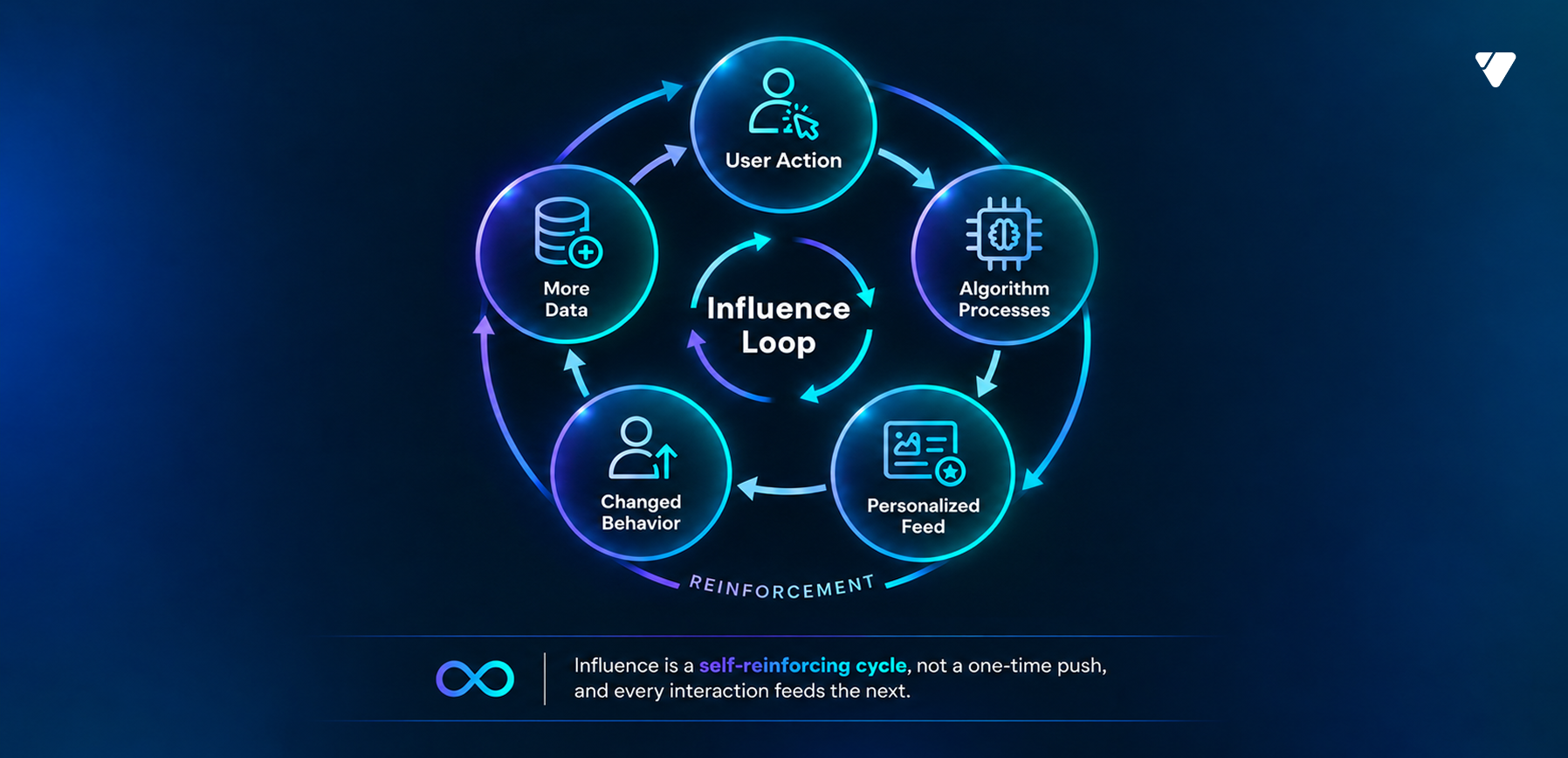
Algorithmic Influence: The Invisible Hand on Enterprise Decisions
Algorithmic influence is the way AI-powered recommendations shape not just what users see, but what they decide and do, often without their awareness. On social platforms, three forces drive it:
- Recommendation engines that rank content by predicted engagement, not relevance or accuracy.
- Targeted advertising matched to inferred intent and buying stage.
- Influencers whose social proof lends human credibility to whatever the feed elevates.
The point is blunt: these platforms do not passively mirror demand; they actively manufacture it. That makes them both a growth lever and a manipulation channel, which is why they belong on the leadership agenda, not just in marketing.
How Social Media Algorithms Actually Work
If you have wondered why you see certain posts on social media, the answer is engagement optimization: the platform’s ranking predicts what will hold attention, then serves more of it. These systems run a continuous loop of data collection, prediction, ranking, and feedback, and every reaction sharpens the next round. The more you engage, the more persuasive the experience becomes, and the harder it is to step outside its framing.
What Social Media Really Knows About Your Workforce
Not all signals carry equal weight. The behaviors users never consciously choose, such as watch time and scroll speed, reveal far more than any deliberate like or comment.
| Signal Type |
Examples |
Why It Matters |
| Explicit |
Likes, follows, comments |
Stated interest, easy to overstate |
| Implicit |
Watch time, scroll speed, re-watches |
Reveals true attention, not intention |
| Contextual |
Location, device, time of day |
Fine-tunes relevance |
| Social |
What similar users engage with |
Predicts wants before they are expressed |
Implicit signals expose more than any public post, which is why online privacy is now a leadership priority, not an individual one. The same behavioral data that personalizes a feed can also create real privacy risks for a workforce.
From Feed to Boardroom: How Algorithms Move Real Decisions
Once the system knows what moves someone, it steers decisions across the enterprise. Social platforms increasingly drive purchasing directly: according to the Pew Research Center, three-in-ten adult social media users say they have bought something after seeing an influencer or content creator post about it, and among users who follow such accounts, that figure rises to 53%. The effect reaches well beyond retail:
Investing: Viral sentiment fuels herd behavior, where meme stocks and crypto rallies become algorithmic events as much as financial ones.
Talent: Curated professional feeds shape how candidates judge your employer brand and how employees perceive their own leadership.
The underlying mechanism is simple: repetition plus personalization equals persuasion. The more a tailored message recurs, the more natural and trustworthy it feels. Yet a counter-trend is emerging. Rising skepticism and platform fatigue show audiences pushing back against manufactured desire, making digital wellbeing and authenticity genuine differentiators rather than soft ideals.
Can you trust what you see online?
AI content shapes decisions faster than teams react.
The Perception Trap: Filter Bubbles, Echo Chambers, and Bias
Personalization narrows the field of view. The term ‘filter bubble,’ coined by author Eli Pariser, describes how algorithmic curation hides content the system predicts you will dislike, leaving users unaware of what they no longer see. Three related effects are routinely confused, and each carries a distinct business risk.
| Concept |
What It Is |
Business Risk |
| Filter Bubbles |
Personalized filtering that hides dissenting content |
Blind spots in market intelligence |
| Echo Chambers |
Environment that reinforces existing beliefs |
Groupthink and unchallenged assumptions |
| Algorithmic Bias |
Systematic skew from flawed data or design |
Unfair amplification or suppression |
These dynamics also accelerate the spread of falsehood. Because outrage and novelty drive engagement, the feed can amplify AI-generated misinformation faster than facts spread, distorting the public information that every enterprise relies on. Coordinated campaigns exploit exactly this, seeding false narratives that bots then amplify to damage a brand, sway opinion, or move a share price.
Can Social Media Affect Cybersecurity? The Answer Should Worry You
Social media is now one of the most exploited channels in the enterprise threat landscape because it targets the weakest link: human judgment. According to Verizon’s 2026 Data Breach Investigations Report, the human element was present in 62% of breaches, up slightly from 60% the prior year. This is why the cybersecurity risks of social media belong on the executive agenda, not just in the security operations center.
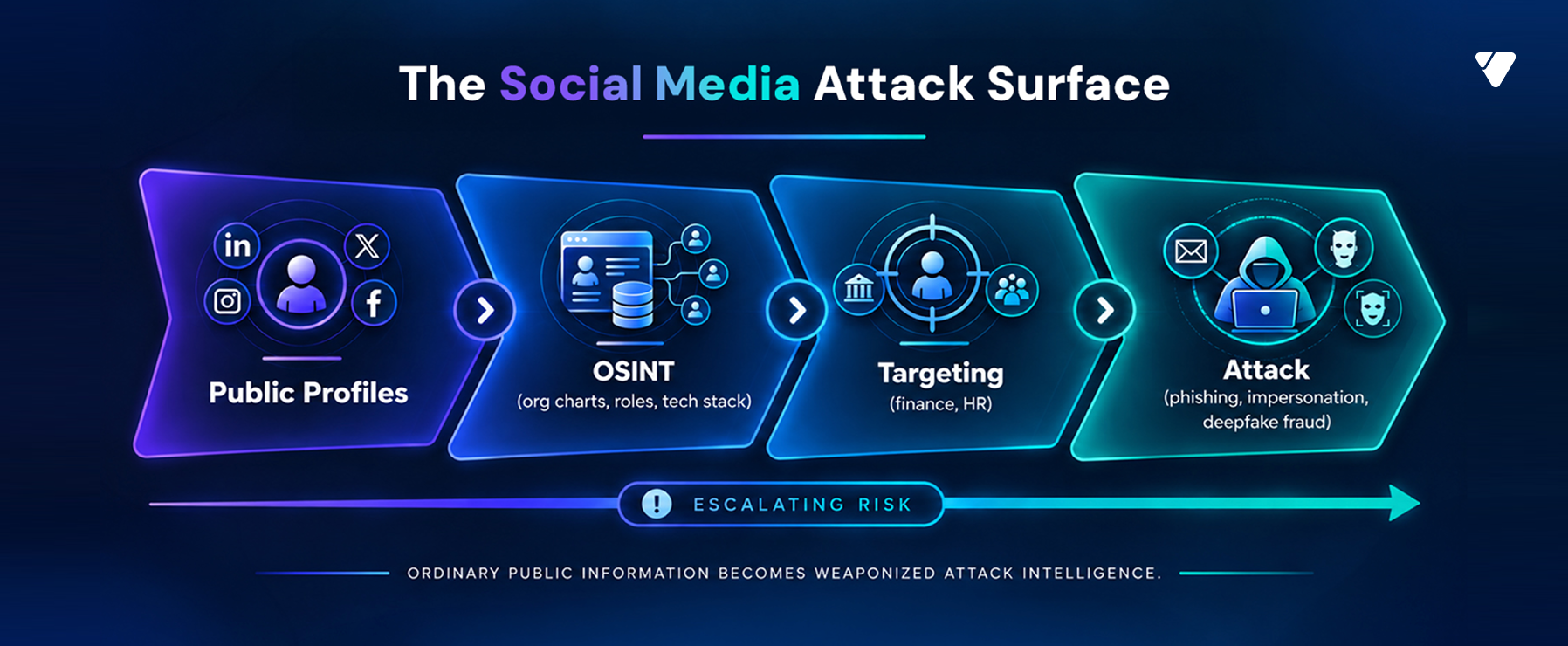
Your Employees' Profiles Are an Attacker's Blueprint
Public profiles are a goldmine for open-source intelligence. From a handful of employee pages, adversaries can:
- Reconstruct org charts, reporting lines, and technology stacks.
- Identify high-value targets in finance and HR.
- Craft convincing spear-phishing lures using real details.
Digital identity protection starts with treating public information as an attack surface.
The Attack Vectors Every Leader Should Recognize
| Attack |
How It Works |
Primary Targets |
| Phishing |
Malicious links via DMs or fake profiles |
Employees, customers |
| Executive Impersonation |
Fake leadership accounts requesting action |
Finance, HR teams |
| Data Harvesting |
Mining public posts for intelligence |
Whole organization |
| Coordinated Misinformation |
Bot-amplified false narratives |
Brand and reputation |
Reducing exposure means clear guidance on what employees share publicly, ongoing social media cybersecurity awareness, and continuous monitoring for brand and executive impersonation. The organizations that fare best treat this as a culture and training problem, not a purely technical one.
How Brand Manipulation Campaigns Shape Business Decisions
Algorithmic amplification not only sways individuals, but it also reshapes how customers, investors, and partners perceive a brand. Coordinated misinformation campaigns now spread false narratives faster than official communications can respond, especially when AI-generated content, fake accounts, and recommendation engines work in concert.
The tactics are familiar but increasingly automated:
- Fake reviews and bot-amplified narratives that inflate or destroy reputation on cue.
- Impersonation of leaders via fake profiles or synthetic media erodes public trust.
- Fabricated announcements designed to confuse customers or move markets.
- Viral misinformation that erodes customer confidence, investor sentiment, or recruitment.
The takeaway is blunt: brand reputation is now part of cybersecurity. Protecting digital trust demands continuous monitoring, rapid responses to misinformation, and employee awareness alongside traditional controls.
What Are Deepfake Attacks, and Why Are They a Board Issue?
A deepfake is synthetic media, image, audio, or video, generated by AI to impersonate a real human, according to Merriam-Webster. What was a novelty three years ago is now an operational weapon. According to Deloitte, Generative AI-enabled fraud losses in the US could reach around US$40 billion by 2027, up from US$12.3 billion in 2023. While that projection is US-focused, the threat is global: finance and communications teams worldwide now face the same synthetic-media risk, and no market is insulated from it.
The damage extends well beyond fraud:
- Financial fraud: Cloned executives authorizing transfers or vendor changes.
- Market and reputation shocks: Fabricated statements from leaders moving stock or triggering PR crises.
- Synthetic identities: Convincing fake personas enabling scams and fraudulent recruitment.
Strengthening these defenses is no longer optional for finance and communications teams.
How to Detect and Defend Against Synthetic Media
| Red Flag |
What to Look For |
| Visual glitches |
Unnatural blinking, odd lighting, blurred edges |
| Audio mismatch |
Lip-sync errors, robotic tone shifts |
| Contextual oddities |
Urgency, secrecy, unusual payment requests |
| Verification gaps |
No corroboration from trusted channels |
The rule of thumb: verify high-stakes requests through a second, independent channel. On the technology side, AI content authentication standards such as C2PA / Content Credentials are emerging as the defensive frontier, cryptographically signing media to prove origin and detect tampering. This is how trust across these platforms gets rebuilt at scale.
Is your enterprise deepfake-ready?
Build defenses that blend AI Agents and humans.
What This Means for the Enterprise
This dynamic is now a cross-functional risk that touches nearly every leadership portfolio:
Marketing: Algorithms extend reach, but over-reliance breeds fragility when platform rules shift.
HR and employer brand: Curated feeds shape candidate perception and internal sentiment.
Investor relations: Viral sentiment can move valuation faster than fundamentals.
Security posture: Every public profile is potential attack intelligence.
Governance: Regulators are pressing hard on social media algorithm transparency and responsible AI.
The enterprises that win treat AI content risks and trust as board-level competencies, closing the gap between fast-moving attackers and slower defenses.
How ValueLabs Can Help
ValueLabs helps enterprises detect and defend against algorithmic manipulation, deepfakes, and social engineering before they cause damage. We combine automated detection with human oversight through AiDE®, our Agentic AI platform that orchestrates AI Agents alongside human experts, with guardrails built in, not bolted on. AI Agents continuously scan for impersonation, anomalies, and synthetic media at scale, while human experts retain judgment in high-stakes, ambiguous decisions where context matters most.
Because most attacks begin with a human, that is where we focus first. One of the AI-driven products of ValueLabs, AiDE Aware delivers social media cybersecurity awareness that turns your workforce into a genuine first line of defense:
- AI-driven phishing simulations that mirror real-world attack techniques.
- Response training that teaches employees to recognize, report, and act on threats.
- Real-time dashboards tracking performance, phishing resilience, and training effectiveness.
Alongside it, we provide:
- AI risk assessment to quantify your exposure to deepfakes, misinformation, and social engineering.
- AI content authentication to verify media and rebuild digital trust.
- Brand and reputation monitoring to detect impersonation and coordinated campaigns early.
Every enterprise faces this differently, so there is no single template. Connect with our team to map the right mix of AI Agents and human oversight for your risk profile.
The Bottom Line
Social media algorithms no longer just drive engagement. They shape decisions, workforce behavior, public perception, and security exposure at once. Left unmanaged, the reach that grows markets can narrow judgment, spread falsehood, and open the door to eight-figure fraud. For leadership, algorithmic influence is now a strategic reality, and digital trust is the first line of defense.