When Your Tests Start Thinking for Themselves
For three decades, test automation ran on a simple bargain. Humans decided what to test, and machines executed. It worked, but it never scaled. Suites grew brittle, maintenance outpaced creation, and coverage always trailed development.
Agentic testing rewrites that bargain. Instead of executing instructions, AI testing agents pursue goals: reading a requirement, writing tests, running them, and returning ranked failures with a probable cause for each.
But raw capability is only half the story. The teams that win treat autonomy as a dial to set, not a switch to flip, keeping humans accountable through supervised autonomy. That balance is the heart of this piece.
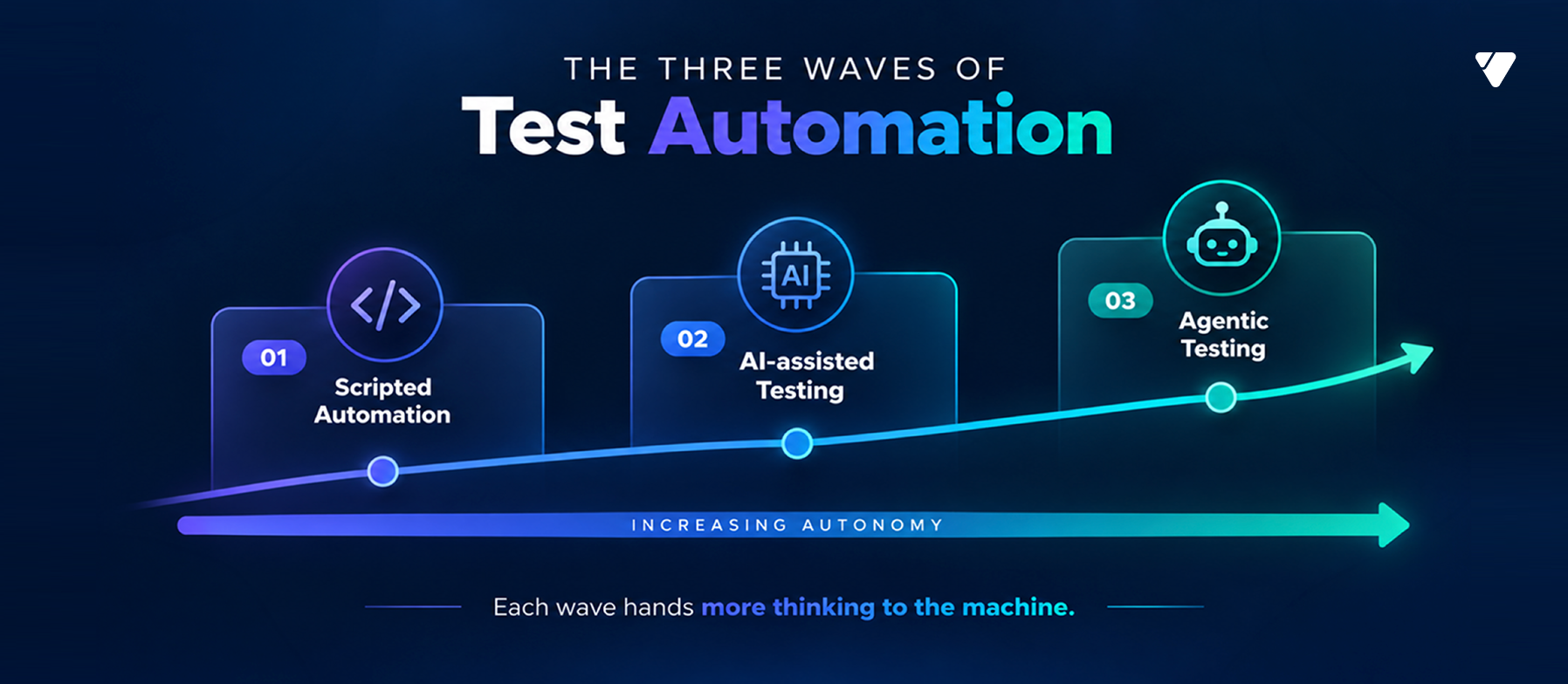
Stage 1: Scripted Automation
Ran fixed instructions through record-and-playback frameworks. Machines executed, and humans thought.
Stage 2: AI-assisted testing
Added self-healing locators and visual validation, but humans still owned the logic.
Stage 3: The Agentic Wave
Hands over the reasoning to AI Agents, which plan and act while humans supervise.
Each wave delegated more cognitive work to the machine, which is why the question of how much to delegate now matters more than ever.
What Makes a System Agentic?
A genuinely agentic system combines several traits:
- It acts without step-by-step instructions and works toward a defined goal.
- It perceives its environment by reading requirements, interfaces, and logs.
- It uses tools such as test frameworks and pipelines.
- It remembers context and adapts when conditions change.
The timing is right. The numbers show how fast adoption is arriving:
| Finding |
Source |
| 88% of organizations now use AI in at least one business function, up from 78% a year earlier |
McKinsey, State of AI |
| Only about a third of organizations have scaled AI enterprise-wide |
McKinsey, State of AI |
| Just 17% of organizations have deployed AI agents so far, though more than 60% expect to within two years |
Gartner, Hype Cycle for Agentic AI, 2026 |
| 40% of enterprise apps will carry task-specific AI agents by the end of 2026, up from under 5% in 2025 |
Gartner |
Adoption is real, and it is arriving fast. The gap is trust, and a disciplined approach to AI in software testing has to earn it.
What Can AI Agents Actually Do Across the Testing Lifecycle?
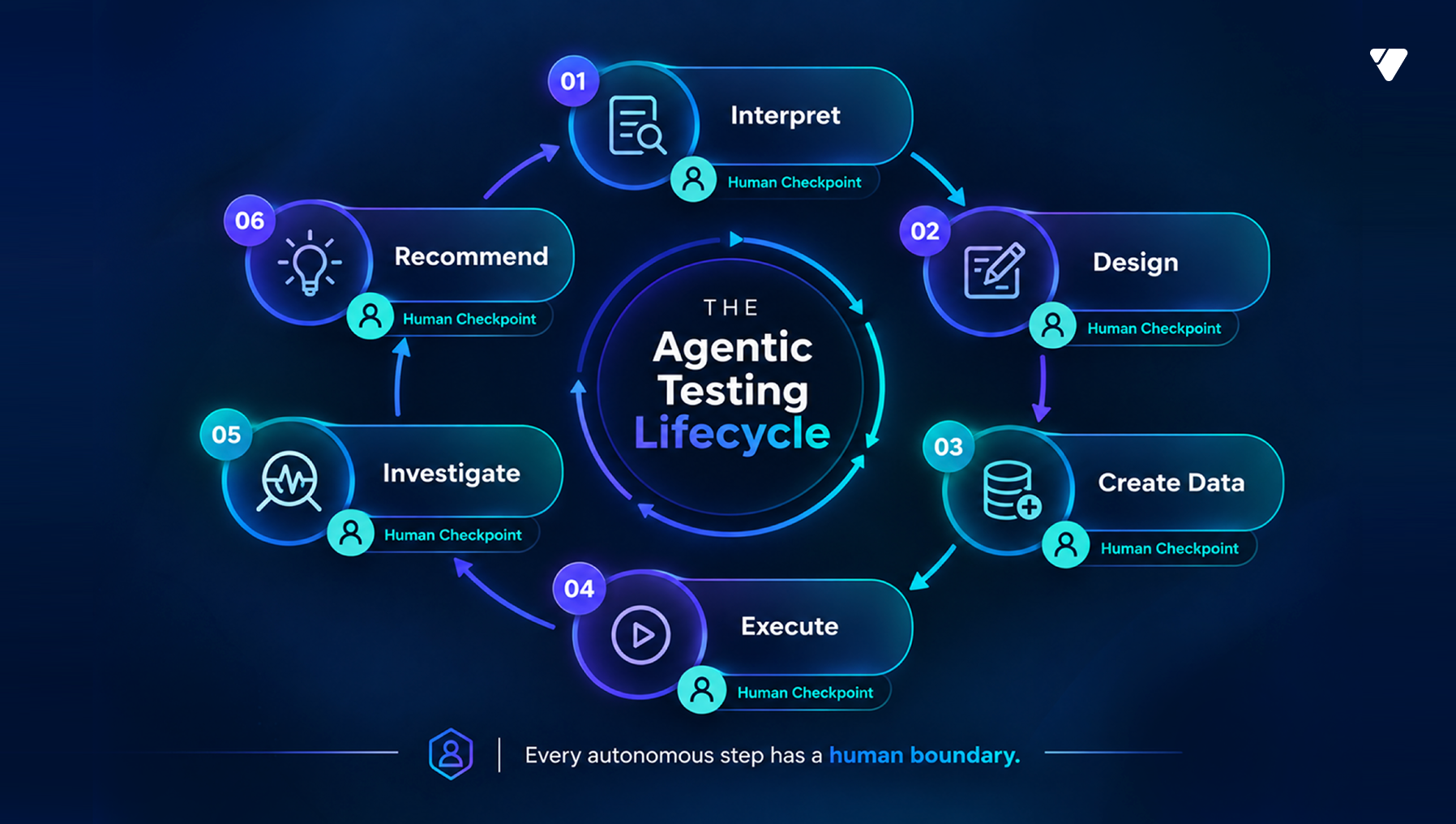
Agentic testing is a chain of connected capabilities. Each takes over work that traditionally sat with a human, and each carries a boundary where human judgment still belongs.
Interpreting Requirements
An AI Agent reads user stories, product documents, and design files, then derives the scenarios worth testing. It also surfaces the gaps and ambiguities teams miss under deadline pressure. Final scope remains with a human.
Designing Tests
Through autonomous test generation, it produces test cases, including negative and edge cases that are tedious to create by hand, and prioritizes them by risk. High-risk logic that gates a release still deserves human review.
Creating Test Data
AI Agents generate synthetic, boundary, and compliant masked data on demand. Any access to production-like data is subject to a permission check.
Executing Scenarios
Rather than following a fixed path that breaks when an element moves, it adjusts its path dynamically across browsers and devices. Any action touching production requires an approval gate.
Investigating Failures
The AI Agent performs failure analysis, correlates logs and traces to identify the root cause, and separates genuine bugs from flaky tests, though a human validates before confirming a defect.
Recommending Corrective Actions
Through self-healing testing, it repairs broken tests, suggests fixes, and files enriched bug reports. Merging a fix into the main branch always passes through an approval gate.
Taken together, these capabilities change what an AI Agent is for. It stops being a test executor and becomes a quality investigator.
Key benefits of Agentic Testing
Faster releases:
AI Agents continuously generate and maintain tests, reducing the lag between development and validation.
Wider coverage:
Autonomous exploration reaches edge cases and negative paths that manual scripting often misses.
Lower maintenance:
Self-healing testing repairs broken tests as the application changes.
Faster triage:
AI-powered testing separates real bugs from flaky ones, saving hours of investigation.
Better use of talent:
Engineers shift from repetitive scripting to governing autonomy and owning quality.
Agentic Testing vs. Traditional Test Automation
Intelligent test automation once meant self-healing scripts. Agentic testing goes further, as the contrast shows.
| Dimension |
Traditional automation |
Agentic testing |
| Test design |
Written and maintained by humans |
Generated by AI Agents from requirements |
| Test data |
Set up manually or from templates |
Created on demand, shaped to the scenario |
| Execution |
Fixed scripts that break on change |
Adaptive navigation across the interface |
| Failure analysis |
Manual triage of every failure |
Root-cause investigation, flaky-test filtering |
| Maintenance |
High and constant |
Largely self-managed through self-healing |
| Human role |
Author and operator |
Supervisor and accountable owner |
The last row matters most. This model does not eliminate humans. It moves them from writing scripts to setting goals and owning outcomes. That shift, from operator to accountable owner, is the load-bearing part of the model, and skipping it is where full autonomy goes wrong.
Set Autonomy on Your Terms
See how supervised Agentic testing keeps control in view.
Why Full Autonomy Is the Wrong Goal Today
The obvious question at this point is: if an AI Agent can do all of this, why keep humans involved at all?
Because competence is not the constraint. Trust, accountability, and blast radius are. The following three risks make unsupervised autonomy unworkable today.
Lack of Reliability
The large language models underlying these AI Agents are probabilistic and can produce confident but incorrect output. Gartner reports that only 19% of organizations have high confidence in their vendors’ ability to protect against AI hallucinations, one reason the same research places agentic AI at the peak of inflated expectations rather than the plateau of productivity.
Unclear Accountability
If an AI Agent approves a release that ships a critical defect, responsibility cannot fall to an algorithm. In regulated domains such as finance, healthcare, and safety-critical systems, a named human owner is essential, not optional, particularly as regulation such as the EU AI Act starts treating autonomous decision systems as a compliance category in their own right.
Greater Security Risk
An AI Agent that touches data, environments, and pipelines expands the attack surface, making security and compliance testing central. The more autonomy it holds over irreversible actions, the greater the cost of a single mistake. These are exactly the risks the OWASP Top 10 for Agentic Applications, published in 2026, was built to catalog and mitigate.
So, can Agentic AI replace QA engineers? No. It changes the role rather than removing it . The question is not whether to trust AI Agents, but how to set the dial, which is what supervised autonomy defines.
Supervised Autonomy: The Model That Makes Agentic Testing Work
Supervised autonomy is the difference between autonomous testing that scales in production and a demo that impresses in a controlled setting. AI Agents act within defined boundaries, while humans stay accountable. It works like onboarding a capable new hire: you delegate real work, but within limits. That discipline rests on four pillars.
The Four Pillars
Clear permissions limit each task to what it genuinely requires through least-privilege access, containing security and blast-radius risk.
Audit trails make every decision and line of reasoning traceable, addressing the explainability problem and keeping the system auditable.
Approval gates insert human checkpoints before high-stakes actions such as merging a fix, changing production data, or signing off on a release.
Human accountability ties the model together. A named human remains responsible. The AI Agent assists at scale, but the human decides where it counts.
The practical rule is to delegate cheap, reversible work entirely while keeping high-stakes decisions, such as a regulated release sign-off, close to human hands.
How Do You Adopt Agentic Testing Responsibly?
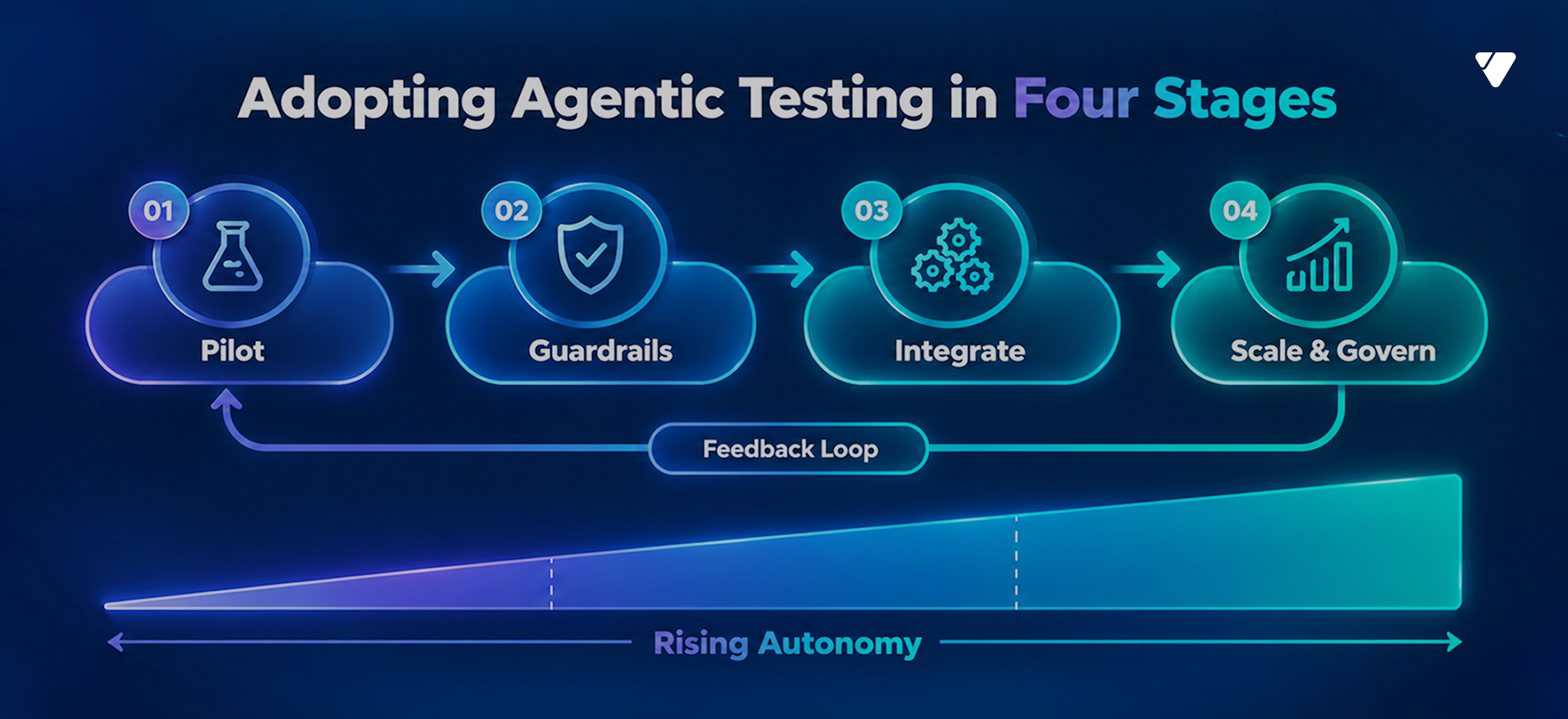
Adoption extends your existing quality engineering practice rather than replacing it, adding autonomy progressively so trust builds alongside it:
- Pilot on low-risk work such as test data generation and flaky-test triage, where early wins build trust without exposing the business.
- Establish guardrails first, scoping permissions, sandboxes, audit logging, and approval workflows before autonomy widens.
- Integrate with existing tools, connecting AI Agents to the CI/CD pipelines and test management tools your teams already use.
- Scale and govern, track agent performance over time, watch for drift or quiet degradation as conditions change, and calibrate autonomy as confidence grows.
The applications that benefit most are evolving alongside the technology. Four patterns stand out right now: test generation triggered automatically by pull requests, so coverage extends the moment code changes rather than waiting for a scheduled regression run; contract and integration testing across microservices, where agents keep pace as the API boundaries between services shift; self-healing coverage for fast-changing, UI-heavy consumer applications, where a single layout change used to break dozens of scripted tests overnight; and multi-step, stateful flows such as multi-factor authentication or token-based sessions, scenarios that traditionally broke scripted automation and needed constant rewriting. More broadly, complex, fast-changing web and mobile applications, systems with large regression suites, and products that release frequently stand to benefit most.
How Does ValueLabs Approach Agentic Testing?
Consider a passenger-facing airline chatbot. Every response had to match business rules and live passenger data, yet manual validation was slow, costly, and risked wrong answers reaching customers. Using AiDE®, ValueLabs proprietary agentic AI platform, AI Agents generated test scenarios, validated booking and loyalty details against live data, flagged response gaps early, and automated regression testing. The result: 90% less QA effort, 80% faster validation, and three to four times the functional coverage.
Crucially, this ran under supervised autonomy. AiDE® agentifies the software delivery lifecycle across planning, development, testing, and operations. Still, human guardrails stay built in, not bolted on: permissions are scoped, actions are logged, high-stakes steps pause for approval, and a named owner stays accountable. AI Agents carry the volume no human team could sustain, and humans keep the judgment. If your strategy still assumes a human must write and repair every test, it is worth a conversation with the ValueLabs quality engineering team.
The Bottom Line: From Executing Scripts to Directing Quality
Agentic testing marks a real shift, from machines that execute instructions to AI Agents that reason across the testing lifecycle. The gains in speed, coverage, and maintenance are genuine, but the winning move is not full autonomy. It is supervised autonomy: clear permissions, audit trails, approval gates, and human accountability. Set the dial deliberately and let AI Agents accelerate the work while humans stay accountable for what ships.