The AI Speed Advantage Comes with a Quality Challenge
AI coding assistants have changed software economics. Features that once took weeks now take hours. But the same AI that speeds up code generation also creates more defects, inconsistencies, and compliance risks. Traditional QA can’t keep pace with this speed. The gap between building code and validating it keeps growing.
Closing this gap takes more than faster testing. It takes a new approach to Quality Engineering. The function is shifting away from manual execution and script maintenance, toward:
- Enterprise-wide risk analysis
- Domain validation
- AI evaluation
- Exploratory testing
- Data-driven quality intelligence
- Release governance
These capabilities let organizations adopt AI at scale without losing quality, resilience, or trust. That makes Quality Engineering a strategic enabler of AI-powered software delivery.
What Does ‘AI-Native Development’ Mean?
AI-native development is a workflow where AI agents generate, refactor, and deploy code as a first-class part of the process, not merely as an assist. Developers shift from authors to orchestrators, reviewing and directing AI output rather than writing every line themselves. Increasingly, Agentic AI systems chain these tasks autonomously.
It’s important to distinguish AI-assisted testing (tools that help human testers work faster) from AI-native testing (testing strategies designed around systems that AI itself built). The latter is the frontier, and it demands a fundamentally different approach to quality assurance.
Traditional QA vs. AI-Native QE: Two Related but Different Roles
QA and QE are related but distinct disciplines, and the shift between them defines where testers’ value is heading.
| Aspect |
Traditional QA |
AI-Native QE |
| Core focus |
Verifying software meets requirements |
Embedding quality across the entire lifecycle |
| Scope |
Output checking |
Design through production monitoring |
| Tester’s role |
Checking output |
Engineering quality systems |
| Where it’s heading |
– |
Defines the future of quality engineers in an AI-native world |
Why More AI-Generated Code Means More Testing, Not Less?
There is a growing gap between velocity and verification. AI generates code near-instantly; human validation does not scale at the same rate. This gap is where risk accumulates.
New Risks AI Introduces That Only Testers Can Catch
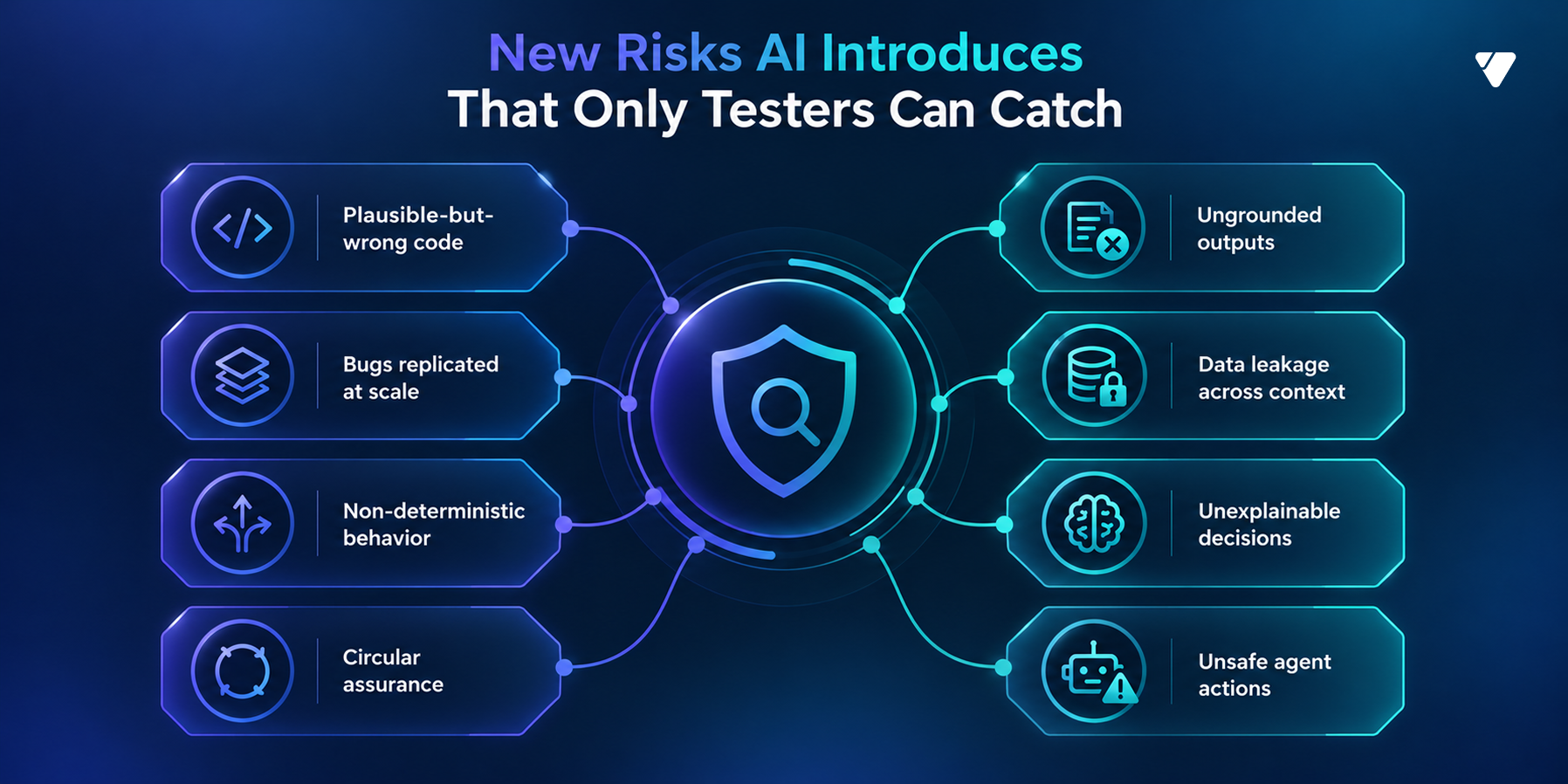
The traditional bulk of testing work, manual execution and regression scripting, is exactly what AI absorbs well. That’s why the value of the tester migrates upstream and downstream, into the six shifts below.
How AI Redefines the Quality Engineering Function?
The impact of AI on Quality Engineering comes down to six strategic shifts. As AI takes over repetitive execution, QE evolves from a delivery function into a governance capability, one that balances development velocity with quality, compliance, and business risk. These shifts show where human expertise matters most.
- From Manual Execution to Risk Analysis
As AI increases code volume, exhaustive testing becomes impractical. Quality Engineering must shift toward risk-based validation, prioritizing business-critical workflows, assessing failure impact, and focusing assurance where enterprise risk is highest.
- From Requirements-checking to Domain Validation
AI optimizes for plausibility, not correctness in context. It doesn’t understand your users, regulations, or business rules. Testers validate whether software is genuinely right for the domain, catching edge cases AI missed.
- From Test Scripting to AI Evaluation
Validating AI itself is a new discipline: testing models and prompts for hallucination, bias, drift, and leakage. Agentic systems need permission checks before autonomy. AiDE®, ValueLabs’ Agentic AI ecosystem, enables this at scale.
- From Regression Runs to Exploratory Testing
Exploratory testing gains value because automation can’t replace it. Curiosity, adversarial thinking, and the instinct to break systems in unscripted ways remain human strengths, even alongside AI-powered testing tools.
- From Bug Reporting to Data Analysis
Modern testers interpret signals: telemetry, test patterns, and model behavior over time. This is quality intelligence. AiDE® surfaces these signals, but skilled testers separate real defects from noise.
- From Test Sign-off to Release Governance
Someone must be accountable for shipping, and that can’t be delegated to a model. Testers own quality gates and the go/no-go decision, the final safeguard for regulatory and ethical quality.
The Business Risk of Underinvesting in Testing
Underinvesting in software assurance during rapid AI-driven development is a strategic risk, not just a technical one. A single AI-generated defect, shipped fast and replicated across a codebase, can cause outsized reputational, regulatory, or financial damage. Testers are the last line of human judgment, and digital assurance is what makes acceleration safe rather than reckless.
Is Your QE Ready for AI?
See exactly where your QE strategy stands today, spot the gaps, and plan a clear roadmap to close them.
AI-Native Quality Engineering in Action
The six shifts described above are not theoretical. ValueLabs has applied them in production environments across one of North America’s largest airlines, where AI-native quality engineering has delivered measurable outcomes at scale.
| Use Case |
AiDE® Application |
Key Outcomes |
| Cloud Modernization |
AWS migration data validation |
33% less scripting, 15M+ records validated monthly, 40+ AI utilities across 35+ apps |
| Reusable QE Accelerators |
Data comparison, log analysis, queue and message validation |
97% less manual effort, 90% faster validation, cycle time cut from days to hours |
| Customer Experience Validation |
Chatbot response testing against business rules |
90% less QA effort, 80% faster validation, 3-4× more functional coverage |
| Test Environment Readiness |
Automated test data provisioning |
Setup cut from weeks to 30-60 minutes, 100% production data fidelity |
The pattern across these engagements is consistent: where AI-powered testing tools handle volume and repetition, human testers govern strategy, interpret results, and own outcomes. That is quality engineering in practice.
Enterprise-Grade Skills Testers Need Now
QE capabilities for the AI era center on six core shifts:
- Risk analysis and prioritization thinking
- Domain expertise to judge correctness-in-context
- AI evaluation fluency, including prompt testing, eval design, and AI model evaluation
- Exploratory and adversarial testing instinct, the human creativity that resists automation
- Data literacy to interpret quality intelligence signals
- Governance ownership for responsible release decisions
To prepare testers for AI-native development, invest in AI/ML fundamentals alongside durable human skills: critical thinking, scepticism, and communication. These are teachable skills, not just innate traits. Testers can build AI evaluation fluency and risk-analysis instinct the same way they once built scripting expertise.
Putting This into Practice
- For individual testers: Build risk-analysis and AI-evaluation skills, sharpen exploratory and adversarial testing instincts, deepen domain expertise, and develop data-analysis capability.
- For QE leaders: Redefine metrics beyond coverage percentage, invest in AI-evaluation tooling, and formalize release governance gates.
Adopt an AI testing strategy grounded in AI assurance best practices, mapping team maturity from manual execution toward full AI-native quality governance.
Will AI Replace Software Testers?
No. AI absorbs manual execution, script maintenance, and boilerplate regression, the very tasks the role is shifting away from. What it cannot own is judgment, domain context, accountability, adversarial creativity, and governance. The lesson is simple: AI replaces tasks, not the responsibility for quality.
History confirms this. Automation frameworks and CI/CD did not eliminate testers; each wave elevated the role. Looking ahead to 2026 and beyond, those who reason, validate, and govern will only become more essential.
Is your Quality Engineering built for AI-native software delivery?
Assess where your QE strategy stands today and build the risk-based, AI-native roadmap to close the gap.
Conclusion: The Tester as the Conscience of the System
Automating creation raises the stakes and the value of validation. The tester’s mandate expands from ‘does it work?’ to ‘should it work this way, is it safe, can we trust it, and are we accountable for it?’ In the AI-native era, quality engineering delivers continuous quality by making acceleration safe. AI doesn’t replace testers; they’re the conscience of the system.
How ValueLabs Can Help
ValueLabs partners with global enterprises to implement quality engineering practices for AI-native development, spanning risk-based testing, human-in-the-loop testing frameworks, AI model evaluation, and release governance. Powered by the AiDE® platform, our quality engineering consulting helps teams embed quality intelligence and digital assurance across the lifecycle, so they ship faster and safer. Connect with us to assess your AI assurance readiness.