What is business intelligence?
Can you afford to make decisions based on guesswork in this current business landscape? Business intelligence (BI) empowers organizations to base decisions on data, not assumptions. BI enables strategic decision-making by analyzing and presenting data in meaningful and easily understandable formats like charts, reports, and BI dashboards. It focuses on helping you understand the past and current performance to answer the ‘what’ and ‘why’ questions, which will then guide you towards the ‘how’.
To better understand BI, let’s consider this example:
A manufacturing company aims to evaluate production efficiency across its plants. Using a BI tool, they create interactive dashboards to track daily production rates and operational costs. The data identifies a key issue: one plant is producing less at a higher cost compared to others, revealing the ‘what’ — the plant is underperforming.
Let’s understand it with a graph:
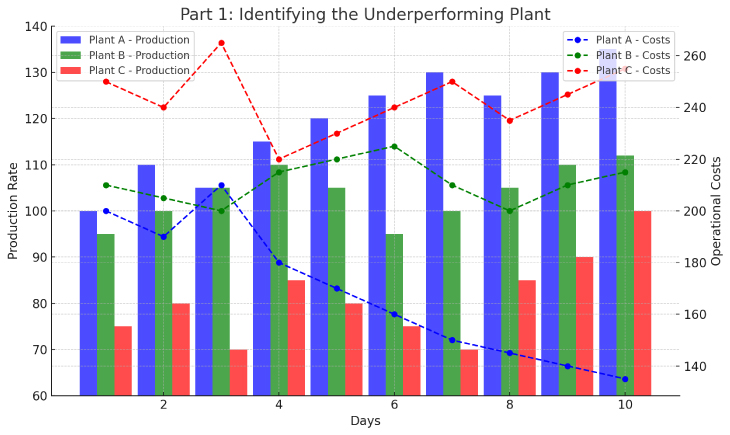
Upon deeper analysis, the company examines equipment maintenance logs and workforce trends. The BI insights highlight frequent machine downtimes and low staffing levels during peak hours as the underlying causes. These insights uncover the ‘why’ behind the underperformance.
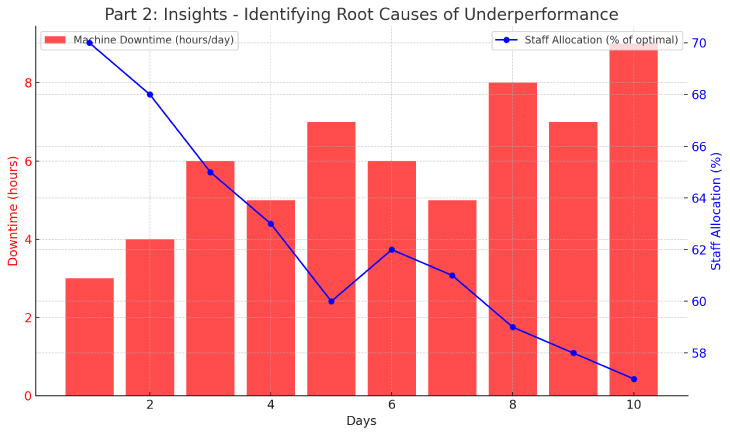
With this understanding, the team reallocates resources and schedules timely maintenance to address inefficiencies. As a result, the plant achieves higher production rates and lower operational costs per unit. BI enables the company to transform data into actionable insights, driving measurable performance improvements and optimized resource allocation.
BI provides monitoring, trend identification, and decision-making support across industries. For example:
- Customer Service: Unified data on customers and products allows agents to address questions and resolve issues quickly.
- Sales Performance Analysis: BI dashboards provide insights into sales performance across regions or time frames, helping sales teams identify best-selling products and underperforming areas.
- Finance & Banking: By combining customer and market data, financial firms can gauge risk, assess health, and make branch-specific improvement plans.