8 Key Benefits of DevSecOps for your Organization
In the past, traditional practice dictated that a security team would secure the software towards the end of the development cycle and then proceed to send it for testing to a quality assurance team. However, with the integration of security at every stage of the development cycle, you not only ease up on security issues in the later stages but also sped up the process via automation.
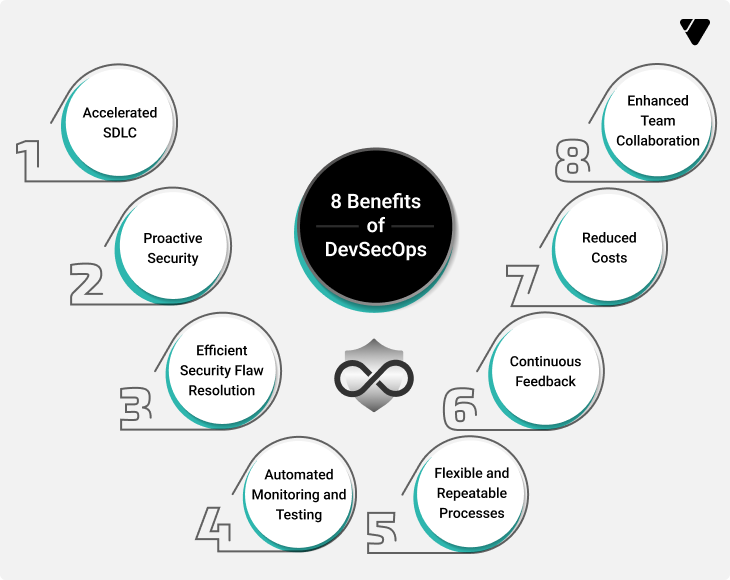
With this in mind, here are 8 benefits of DevSecOps that you can acquire:
- Accelerated SDLC:
The first and foremost advantage is agility and fluidity. DevSecOps enables continuous integration and delivery, allowing organizations to release software faster and more frequently, while maintaining security standards. Automating the build, test, and deployment processes, DevSecOps significantly reduces the time taken to bring new features to market.
For instance, Netflix successfully integrates security into its CI/CD pipelines, enabling rapid feature releases and high system availability while maintaining robust security measures through its DevSecOps implementation. Additionally, smaller startups, leveraging tools like GitLab’s built-in security scanning, have also seen significant acceleration in their release cycles
This acceleration not only enhances competitiveness but also ensures that security is embedded throughout the development lifecycle.
- Proactive security
Integrating security into the Software Development Life Cycle (SDLC) enables DevSecOps to identify and address vulnerabilities early, significantly reducing the risk of costly security breaches. This proactive approach ensures that security becomes a shared responsibility across all team members.
One effective method for achieving this is Static Application Security Testing (SAST). This process uses automated security tools, such as our AiDE® powered DevSecOps solutions, to scan code for vulnerabilities as it is being written. By identifying and fixing issues immediately, developers can prevent vulnerabilities from making it into production, thereby enhancing overall security.
For example, some automated security tools can continuously scan code during the development phase, allowing developers to address potential issues in real-time. Specifically, tools like SonarQube, can be integrated into the CI/CD pipeline, and can block a build if a security vulnerability is found. This not only strengthens application security but also streamlines the development process by reducing the need for extensive rework later.
- Efficient security flaw resolution
Automated testing and monitoring enable swift detection and resolution of security flaws, minimizing downtime and ensuring business continuity.
This allows teams to address security issues promptly, reducing the window of exposure and maintaining the integrity of the software. Efficient flaw resolution is crucial for maintaining customer trust and avoiding potential financial losses.
- Automated monitoring and testing
DevSecOps automation streamlines security testing, reducing manual effort and increasing the frequency of testing, thereby improving overall security. This continuous testing approach helps in identifying and mitigating security risks early, leading to more secure and reliable software releases.
- Flexible and repeatable processes
DevSecOps enables organizations to create repeatable and scalable processes thus making it easier to adapt to changing business needs and security requirements. By standardizing security practices and integrating them into the CI/CD pipeline, organizations can ensure consistent security measures across all projects. This flexibility allows teams to quickly respond to new threats and regulatory changes, maintaining compliance and security standards.
- Continuous Feedback
DevSecOps fosters a culture of continuous improvement, providing real-time feedback and enabling teams to make data-driven decisions. Continuous feedback loops help teams monitor application performance and security in real-time. This data-driven approach allows for quick adjustments and improvements, ensuring that security measures evolve alongside the software.
- Reduce Costs
By identifying and addressing security vulnerabilities early on, organizations can reduce the cost of security breaches and minimize the financial impact of downtime. According to a study by SecurityHQ, the average cost of a data breach in 2023 was $4.45 million. Thus, it is fair to say that DevSecOps implementation significantly lowers these costs by preventing breaches before they occur. Additionally, automated security testing reduces the need for extensive manual testing, further cutting down expenses.
It’s also important to note that the initial investment in DevSecOps tools and training should be considered as a long term investment, rather than a short term expense.
- Enhanced Team Collaboration and Communication
Finally, DevSecOps promotes cross-functional collaboration, ensuring that security, development, and operations teams work together seamlessly to deliver secure and reliable software products. This collaborative approach breaks down silos and fosters a shared responsibility for security. Many upcoming start-ups and established giants such as Netflix and Google have successfully (and quite famously) implemented DevSecOps to enhance team collaboration, resulting in more efficient and secure software development processes.
Adopting DevSecOps as a Service enables organizations to significantly enhance their security, minimize risks, and meet regulatory requirements more effectively, all while achieving cost savings and increased operational efficiency. However, organizations should be aware that the cultural shift required can be a significant undertaking.