Why Do Pod-Owned QE Capabilities Become an Enterprise Scaling Problem?
Pod-owned QE capabilities become difficult to scale when common quality needs are solved independently across pods. Each pod may optimize its own application, but the enterprise can end up repeatedly investing in similar automation utilities, test-data processes, reporting, integrations, and maintenance.
The issue is not that pod-owned QE is ineffective. The problem is that reusable capabilities remain tied to individual pods instead of being made available as shared services. As pods and applications grow, so do the frameworks, tools, assets, and maintenance responsibilities behind them.
How is Duplication Built Across Pods?
One pod builds a login and authentication test utility. Months later, another pod builds a similar utility because the existing one is not easy to discover or reuse. Over time, multiple versions of the utility can emerge, each with its own implementation, maintainer, and maintenance requirements.
The same pattern can repeat across test-data setup, reporting, integrations, and other common QE capabilities, creating duplicated engineering effort and growing maintenance debt.
The answer is not to move all QE into a central team. Pods should retain ownership of product-specific quality, business risks, and application context. A dedicated QE capability team can instead build, operate, or govern reusable capabilities that should not be independently rebuilt by every pod.
Centralize what should be reusable; keep product-specific quality decisions with the pods that own them.
Here is how this actually plays out. A pod builds a login and authentication test utility for its application. Eight months later, a second pod, with no visibility into what already exists, builds its own version, because asking around takes more time than just writing it. Eighteen months and six pods in, there are seven slightly different login utilities to sit across the portfolio, each with its own bugs, its own maintainer, and its own way of quietly breaking. Multiply that pattern across every common utility, test data setup, and reporting pipeline, and the duplication becomes the highest hidden cost in the automation budget.
The Common Challenges of Independently Pod-owned QE Capabilities
- Duplicated frameworks: Multiple pods building variations of the same login, API, and test-data setup utilities create real engineering effort with limited enterprise-wide reuse.
- Inconsistent standards: Different tools, coding patterns, and pass/fail criteria can make quality signals difficult to compare across pods. Leadership loses a consistent portfolio-level view.
- Non-linear maintenance debt: Maintenance effort is driven not only by the number of tests, but also by the independent frameworks, integrations, utilities, and ownership models that must be sustained. Gartner’s research shows the broader shift toward reusable engineering capabilities: by 2026, 80% of large software engineering organizations were expected to establish platform engineering teams, up from 45% in 2022.
- No portfolio-level visibility: When every pod reports against its own standards and tools, leadership has no reliable way to answer the most basic question: what is our actual quality posture across the estate?
- Tooling and skill fragmentation: Onboarding slows, talent doesn’t transfer between pods, and every new pod pays the same setup tax.
Pod-owned QE Capabilities Versus the Capability Team Model
| Dimension |
Pod-owned QE capabilities |
The capability team model |
| Operating model |
Pods independently build and manage supporting QE capabilities |
A shared QE capability team provides reusable services to pods |
| Automation |
Pod-specific frameworks, utilities, and scripts |
Reusable automation services, reference patterns, and assets |
| Tools and standards |
May vary independently across pods |
Common governance with flexibility for application needs |
| Test data |
Often managed independently by each pod |
Shared test data management services with domain-specific configuration |
| Quality gates |
Defined and maintained independently per pod |
Reusable, governed quality policies and guardrails |
| Reporting |
Can become fragmented across pods |
Consistent enterprise-level quality visibility with pod-level context |
| AI capabilities |
Integrated separately into individual pods |
AI capabilities exposed as shared, governed QE services |
| Maintenance |
Repeated across multiple frameworks and utilities |
Shared capabilities reduce duplicated maintenance |
| Scaling |
More pods can mean more duplicated capability ownership |
More pods can increase reuse of shared capability |
| Pod experience |
Build, integrate, and maintain common capabilities locally |
Discover, consume, configure, extend, and improve |
| Primary challenge |
Duplication, fragmentation, and uneven standards |
Governance, adoption, service quality, and continuous evolution |
| Core principle |
Scale through local ownership and replication |
Scale reusable concerns through shared services |
What is the Capability Team Model?
The capability team model is an enterprise approach in which a dedicated capability team builds commonly required quality engineering capabilities as reusable services, and pods consume them through a self-service model rather than rebuilding them independently.
How is a Capability Team Different from a Test Automation Framework?
A test automation framework provides the technical structure to build and run tests. A capability team goes further by turning commonly needed QE capabilities into reusable, governed services that multiple pods can consume through self-service.
The distinction is therefore not simply a capability team versus a framework. It is independently rebuilding reusable capabilities within each pod versus providing those capabilities as shared enterprise services.
The capability team standardizes reusable capabilities and governance without taking away the engineering judgment or product-specific quality decisions that remain with each pod.
The model follows many of the same principles used in modern platform engineering. Team Topologies distinguishes stream-aligned teams, organized around a flow of product work, from platform teams that provide internal, self-service capabilities, so stream-aligned teams do not each have to build the same supporting services themselves. In this analogy, pods remain in stream-aligned product teams, while the QE capability team provides a platform-like layer for reusable quality services rather than infrastructure.
What Should a QE Capability Team Provide?
An enterprise QE capability team brings recurring quality capabilities into a shared foundation. Pods can reuse common services while retaining control over application-specific testing and risk decisions. Test data is a good example of why this matters: Capgemini and Sogeti’s World Quality Report 2025–26 found that 67% of organizations face data privacy and security roadblocks when scaling quality workflows, making it a strong candidate for a shared enterprise capability rather than a problem each pod solves independently.
The capability team model in practice
In one ValueLabs engagement, manual reconciliation across legacy and AWS data stores made large-scale data integrity validation slow, error-prone, and difficult to scale.
What ValueLabs built:
- Reusable framework. Modular, parameter-driven validation across Oracle, DocumentDB, CouchDB, Kafka, files, and services.
- 33% less scripting effort.
- 15 million+ records validated monthly.
- 40+ AI utilities across 35+ applications.
Is QE Duplication Slowing Your Teams?
Identify where your QE effort is being duplicated.
Why is Self-Service the Key to Scaling the Capability Team Model?
Centralizing capabilities is not enough. If pods still depend on a central QE team to access them, the capability team becomes a bottleneck. Self-service lets pods discover, configure, and consume approved capabilities within their workflows.
A simple operating model looks like this: discover, configure, consume, analyze, improve.
The capability team provides shared QE services, standards, governance, reusable assets, engineering support, and common quality policies.
Pods provide application context, business risk, domain knowledge, application-specific scenarios, and feedback and improvements.
This is one of the key benefits of the capability team model: centralize what should be reusable, decentralize what requires product context.
That principle is critical to an effective capability team. The team should make pods faster without taking ownership of quality away from the people who understand the product.
How AI Strengthens the Capability Team?
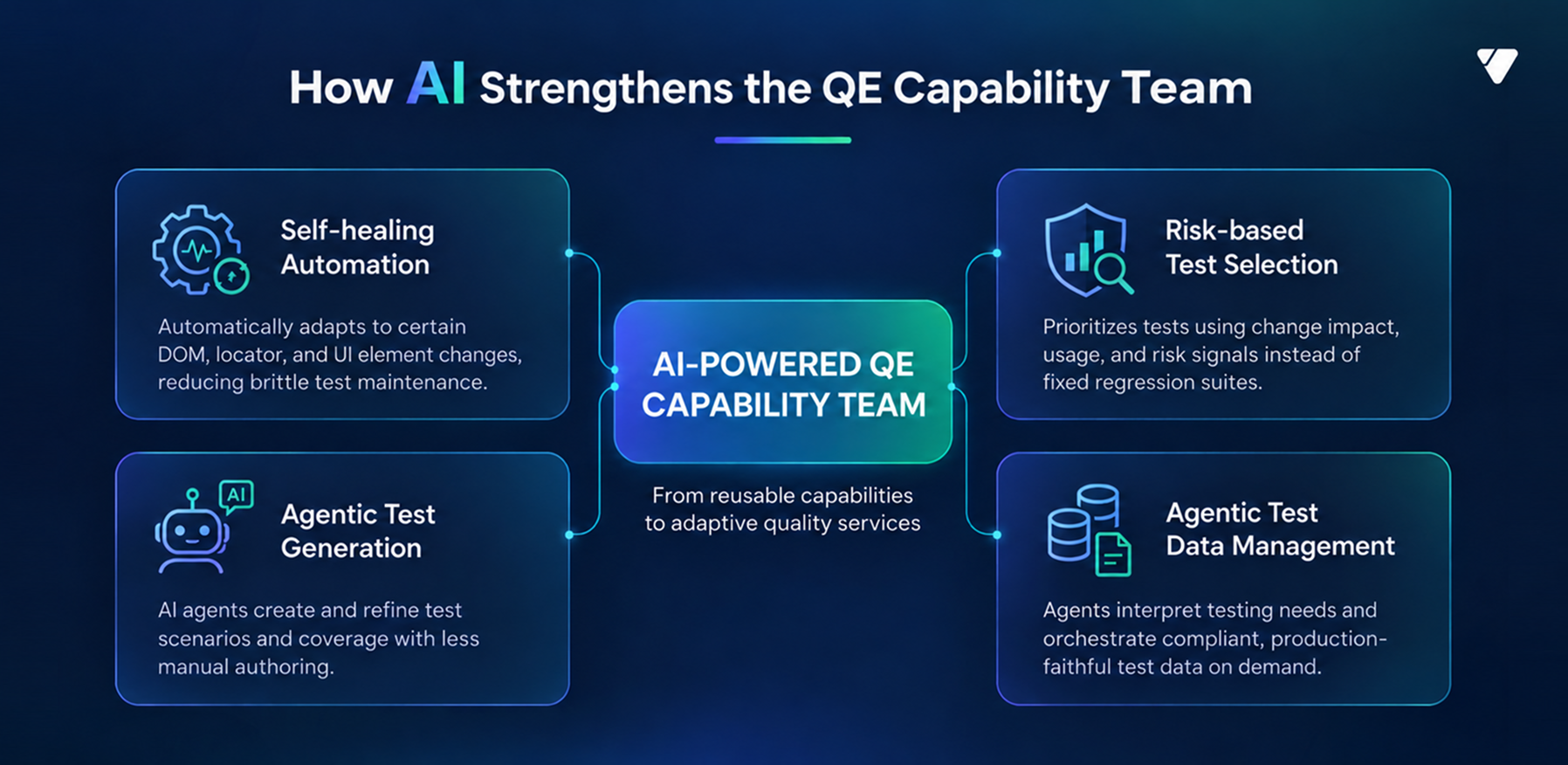
AI can move the capability team from reusable to adaptive. AI-powered testing can automate individual testing activities, while agentic AI can coordinate multiple testing actions, using context and risk signals to determine what to do next within defined guardrails.
Delivered as shared capability team services, this can enable:
- Self-healing automation that can recover from certain DOM, locator, and UI element changes, reducing brittle-selector maintenance.
- Risk- and usage-based test selection, where agents prioritize testing based on change impact and usage rather than fixed regression scripts.
- Agentic test generation, where AI agents create and refine coverage with less manual authoring.
- Agentic test data management, an emerging approach in which agents can interpret testing needs and orchestrate compliant, production-faithful test data on demand instead of every pod maintaining its own static data sets.
AiDE® , ValueLabs’ proprietary Agentic AI platform, brings this model into the quality engineering lifecycle, supporting autonomous test authoring, execution, self-healing, impact-based testing, and continuous testing across CI/CD. It can also identify potentially affected test cases when code changes, helping pods focus on regression testing on relevant scenarios.
The trade-off leaders must weigh is platform consolidation. Unified TestOps platforms can bring test generation, execution, healing, and AI-powered reporting into one stack, creating a more coherent experience. But consolidation can also increase vendor dependency and make it harder to understand why a test was generated, healed, prioritized, or skipped.
The principle should be simple: centralize reusable quality capability without turning the intelligence behind it into a black box. This makes AI agent observability increasingly important: organizations need visibility into what deployed agents do over time, why they take actions, and whether their behavior remains within intended guardrails. AI services should remain governed, observable, and interoperable where practical.
Stop Rebuilding QE Capabilities Across Every Pod
Build a scalable QE foundation with reusable services, AI-powered testing, governance, and self-service capabilities.
The QE shift: from Execution to Orchestration
As AI-powered testing and shared capability services absorb more repetitive execution and maintenance, the QE role shifts toward quality orchestration without removing product-level QE from the pods.
QE work increasingly focuses on quality strategy, product and business risk, governance, validation of AI-driven testing, and deciding where human judgment remains essential.
Greater autonomy also creates a new responsibility: governing the automation itself. AI-generated tests can miss business-critical risks; self-healing can mask meaningful application changes, and automated test selection can overlook low-frequency, high-impact scenarios. That is why pod QEs and the capability team need explicit human-review thresholds, observable AI behavior, and clear ownership of quality decisions.
The future of QE is therefore not simply autonomous testing. It is governed by autonomy, where AI can handle more execution while QEs retain responsibility for quality strategy, risk assessment, and validation, and product teams remain accountable for product quality.
| Pod QE responsibilities |
QE capability team responsibilities |
| Own product-specific quality risks, scenarios, and acceptance context |
Build, operate, or govern reusable QE capabilities |
| Create or adapt application-specific automation where needed |
Provide shared automation services, reference patterns, and integrations |
| Perform exploratory testing and validate product behavior |
Provide governed AI-powered testing services and guardrails |
| Define product-level coverage priorities based on business risk |
Define reusable quality policies, standards, and platform-level controls |
| Investigate application failures and interpret business impact |
Provide cross-pod quality signals, observability, and reusable diagnostics |
| Contribute feedback and improvements to shared services |
Productize capabilities with documentation, versioning, support, and feedback loops |
| Remain part of the product team accountable for product quality |
Measure adoption, reuse, service quality, and enterprise-level outcomes |
How Should Enterprises Build a QE Capability Team?
Building an enterprise QE capability team does not require enterprises to create a massive team before seeing value.
A more practical path is incremental.
• Start with the Highest-reuse Capabilities
Identify where multiple pods are solving the same QE problem. Automation utilities, test data, reporting, environment validation, and common quality gates are potential starting points.
• Standardize the Interfaces
Pods don’t need identical frameworks. They need predictable ways to consume shared services.
• Productize QE Capabilities
Treat reusable automation and testing capabilities as products with ownership, documentation, versioning, service expectations, and feedback loops.
• Introduce Self-service
Make the capabilities discoverable and consumable through workflows, APIs, portals, or pipeline integrations.
• Add AI Selectively
Introduce AI where it addresses a demonstrated problem, such as test prioritization, analysis, maintenance, or generation, rather than adding AI simply because the capability team can support it.
• Measure Reuse and Outcomes
The success of a QE capability team should not be measured only by the number of automated tests.
More meaningful questions include:
- How many pods reuse the capability?
- How much duplicated engineering has been avoided?
- Which quality risks remain insufficiently tested?
- What percentage of pods consume shared capabilities without central-team intervention?
- How long does it take to enable a new pod or application on the shared QE foundation?
- How has automation maintenance effort per release changed as reuse increases?
- How have feedback time, defect leakage, and risk coverage changed?
- For AI-enabled capabilities, what are the human override, false-heal, and AI-generated test acceptance rates?
How ValueLabs Can Help
This shift toward quality orchestration requires more than adding AI to existing automation. It requires a QE foundation where reusable capabilities, agentic AI, governance, and human judgment work together.
That is the direction ValueLabs takes with its Quality Engineering Services. AiDE® brings capabilities such as autonomous test authoring, execution, self-healing, impact-based testing, and CI/CD integration into the QE lifecycle, supported by governance and guardrails.
For enterprises moving toward the capability team model, the focus is on building reusable quality capabilities that pods can consume, govern, and improve across the delivery lifecycle.
Conclusion
Enterprise test automation scalability is not ultimately a question of how many tests an organization can automate. It is a question of how effectively it can turn quality capabilities into reusable enterprise assets.
The capability team model provides that shift: shared automation, test data, quality gates, observability, reporting, domain-specific assets, and agentic AI made available through a governed self-service model. Pods retain ownership of product-specific risk, while the capability team reduces the need to rebuild capabilities that can be shared across the enterprise.
AI extends this model further, moving QE from predefined execution toward adaptive, risk-aware testing. As more execution becomes autonomous, the QE’s role shifts toward orchestration, governance, and judgment, ensuring that greater automation still produces trustworthy quality decisions.